Breath–Movement Meditation for Mobility: A Gentle Daily Practice for Seniors
This post contains affiliate links. As an Amazon Associate, I earn from qualifying purchases at no extra cost to you.
Free resources — no credit card required for trial
🎧 Listen to health & wellness audiobooks free for 30 days
Start 30-Day Free Trial →
🛒 Recommended Products
As an Amazon Associate we earn from qualifying purchases at no extra cost to you.
TheraBand First Step to Active Health Kit — Senior Exercise Program for Balance and Fall P
$19.99
EZ Off Jar Opener for Seniors — Under Cabinet Jar Opener for Weak Hands and Arthritis
$9.99
Omron 5 Series Upper Arm Blood Pressure Monitor — 2-User 100-Reading Memory Wide-Range Cuf
$44.99
OMRON 7 Series Wireless Wrist Blood Pressure Monitor — Clinically Validated with Connect A
$69.99
Vitality 4 Life Senior Resistance Band with Instruction Guide — Specifically for Elderly F
$16.99
📚 Read unlimited health books free for 30 days
Try Kindle Unlimited Free →
If your mornings begin with stiff joints, slower movements, or that familiar ache that seems to settle in overnight, you’re far from alone. Many older adults find that their bodies simply don’t move the way they used to — and that can feel frustrating, even discouraging. But here’s some genuinely good news: breath–movement meditation for mobility is a simple, gentle practice that blends slow, intentional breathing with easy movements to help loosen joints, soften muscles, and calm the mind — all from the comfort of your own home, in a chair if you need it, in just a few minutes a day.
What Is Breath–Movement Meditation and Why Does It Work?
Breath–movement meditation isn’t a complicated yoga class or an intense workout. It’s exactly what it sounds like — pairing mindful breathing with gentle, slow movement so that the two work together to release tension and improve how your body feels. Think of it as a conversation between your breath and your body, where each exhale is an invitation to let go of tightness, and each inhale brings a sense of length and space.
When you exhale, your muscles naturally begin to soften. That’s the perfect moment to ease into a stretch or a gentle twist. When you inhale, you create a little more room in your spine and torso. By timing your movements to your breath, you’re not forcing anything — you’re flowing with your body’s natural rhythms. This is what makes the practice feel so different from conventional stretching.
Slow, mindful movement also helps keep your joints lubricated and your muscles balanced, which over time can reduce that everyday stiffness that creeps in. And because you’re focusing your attention on what your body is actually feeling, you develop a stronger mind–body connection — meaning you become more aware of what your body needs and can respond with genuine care rather than pushing through discomfort.
Safety and Comfort: Getting Started on the Right Foot
Before anything else, your comfort and safety come first. If you have a serious back, knee, hip, or heart condition, have had a recent injury, or notice that movement tends to worsen your pain, it’s a good idea to have a quick chat with your healthcare provider before beginning any new movement practice. This isn’t meant to put you off — it’s simply about making sure you can enjoy the practice fully and safely.
Setting up a safe space takes just a moment. Choose a sturdy chair with a firm back, or stand near a wall or another chair you can hold onto for balance. Wear comfortable clothing and flat-soled shoes. Keep a glass of water nearby, and if you like, dim the lights a little and reduce noise to help create a calm atmosphere. Small details like these make the practice feel like genuine self-care rather than a chore.
The golden rule throughout this practice is to move within your comfort zone. There is no goal of touching your toes or achieving a perfect posture. If something causes sharp pain, stop it immediately and either try a smaller range of motion or skip that movement entirely. You should be able to speak in short phrases during the practice — if you feel breathless, lightheaded, or dizzy, simply sit down, rest, and breathe slowly until you feel settled again.
A Simple Breath–Movement Meditation Sequence You Can Try Today
This sequence is designed specifically for beginners and older adults. It takes around 10 to 15 minutes, and every movement can be done seated in a chair if standing feels uncomfortable or unsafe. Start by sitting tall with your feet flat on the floor, or stand near a wall with feet about hip-width apart. Rest your hands on your lap or by your sides, and aim for a gentle breathing tempo — roughly four counts in through your nose, four counts out.
Begin with a grounding breath: four slow counts in, four slow counts out, letting your shoulders soften with each exhale. Do this for four to six breaths just to settle in. Then move gently into neck circles — small, slow rotations, three in each direction — allowing each exhale to release a little tension in the neck and upper back. Follow this with shoulder rolls: inhale as you lift your shoulders toward your ears, exhale as you roll them back and down. Six to eight rolls is plenty.
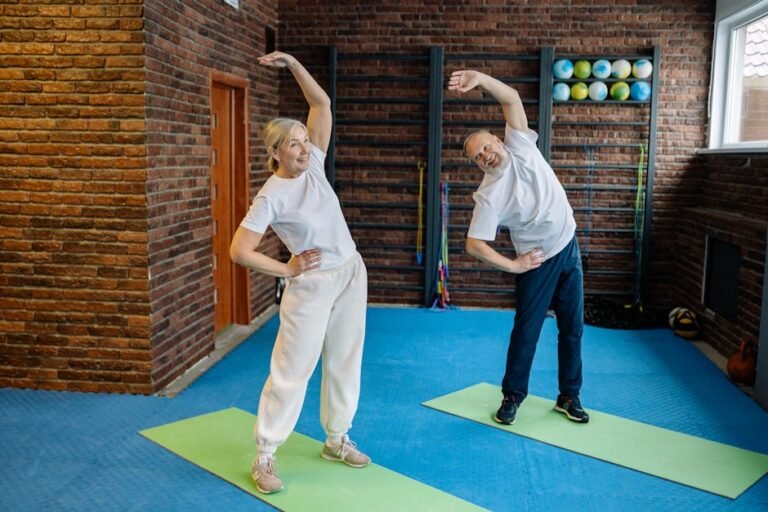
From there, try a gentle seated torso twist — inhale to lengthen your spine, exhale to rotate slowly toward one side, then return to centre on an inhale and switch. Move through a side stretch by reaching one arm overhead on an inhale and lowering it on an exhale. A seated cat–cow (gently arching and rounding your back in time with your breath) works beautifully for the mid and upper spine. Hip lifts — raising one knee slightly on an inhale, lowering on an exhale — help awaken the lower body, and slow ankle circles wrap up the physical movement with attention to circulation in your feet. Finish with four slow, settling breaths and a moment of quiet gratitude.
Modifications So Everyone Can Participate
One of the most wonderful things about breath–movement meditation for mobility is how adaptable it is. There is no single “correct” version of this practice — there is only the version that works for your body today. And that might look different from one morning to the next, and that’s perfectly fine.
If balance is a concern, keep one hand or forearm resting lightly on a wall throughout. If your range of motion is limited, simply make all movements smaller — the benefit comes from the mindful attention and the breath coordination, not from how far you can reach or twist. A light towel or a fabric belt can assist with stretches if you have limited flexibility, and a small rolled towel placed behind your lower back in the chair can support better upright posture during the seated movements.
If you’re having a particularly stiff or uncomfortable day, you can shorten the sequence to just three or four movements and stay entirely focused on your breath. Even five minutes of gentle, intentional movement paired with slow breathing offers real benefit. The practice should always feel like kindness toward your body — never like a battle with it.
What You Can Do: Practical Tips for Making This a Daily Habit
Consistency is what transforms a nice idea into a genuine habit — and gentle, low-pressure approaches tend to stick far better than ambitious routines that demand too much too soon. Here are some straightforward ways to weave breath–movement meditation into your daily life:
- Start small and build gradually. Even five minutes a day is a meaningful beginning. As it starts to feel comfortable and natural, slowly build toward 10–15 minutes.
- Pair it with an existing routine. Practicing right after waking up, just before breakfast, or before bed attaches the new habit to something you already do — making it much easier to remember.
- Keep it simple. Choose two or three favourite movements and breathe through them. You don’t need to complete the full sequence every time to benefit.
- Listen to your body each day. If your breath feels shallow, slow down. If you’re tired, do a shorter version. If you feel energised, you might add a movement or two. Let how you feel guide you.
- Create a calm environment. Soft lighting, a quiet space, and a comfortable chair all help signal to your brain that this is a moment of rest and care.
- Note small wins in a journal. Jot down anything that felt a little easier, more comfortable, or more relaxing than before. These small observations build motivation and help you track your progress over time.
- Bring the practice into daily moments. Apply the same breath-awareness approach when brushing your teeth, reaching for something on a shelf, or turning to look over your shoulder. Mindfulness doesn’t have to be confined to a dedicated session.
The Subtle Shifts You May Begin to Notice
Progress with breath–movement meditation tends to be gentle and gradual — which is exactly as it should be. You may not notice dramatic changes overnight, but over days and weeks of consistent practice, subtle shifts often begin to emerge. Many people find that transitions from sitting to standing start to feel a little easier. Morning stiffness may begin to ease more quickly. A short walk around the block might feel less effortful. And perhaps most meaningfully, there’s often a sense of mental clarity and calm that carries through the rest of the day.
These aren’t small things. For older adults, maintaining mobility and a sense of ease in everyday movement is closely tied to independence, confidence, and overall quality of life. When your body moves with a little more comfort, everything from cooking a meal to visiting a friend feels more accessible. And when your mind is calmer and more present, daily challenges feel a little more manageable.
It’s also worth remembering that this practice isn’t about competing with a younger version of yourself or measuring up to anyone else. Age brings different strengths, and the wisdom to move with patience and care rather than force is one of them. Breath–movement meditation honours exactly that — meeting your body where it is today, with gratitude and kindness.
The Bottom Line: Breath–movement meditation for mobility is one of the most accessible, gentle, and genuinely supportive practices you can build into your daily routine as an older adult. By combining slow, intentional breathing with easy movements, you can help loosen stiff joints, soften tight muscles, improve circulation, and bring a calmer, clearer quality to your mind — all without leaving your home or needing any special equipment. Start with just five minutes, choose movements that feel good for your body today, and let the practice grow naturally from there. Your body, guided by your mindful attention, is capable of ongoing comfort and quiet growth. Begin with one gentle breath today.
This is not medical advice. Consult your healthcare provider before starting any new health routine or using any product mentioned here.