How Lower Extremity Dysfunction Affects Your Spinal Health: The Hidden Connection Between Your Feet and Your Back
This post contains affiliate links. As an Amazon Associate, I earn from qualifying purchases at no extra cost to you.
Free resources — no credit card required for trial
🎧 Listen to health & wellness audiobooks free for 30 days
Start 30-Day Free Trial →
🛒 Recommended Products
As an Amazon Associate we earn from qualifying purchases at no extra cost to you.
Branfit Shoulder and Back Brace Posture Corrector — Breathable Posture Trainer for Upper B
$24.99
Posture Corrector for Women and Men — Comfortable Effective Brace for Shoulder and Back Pa
$22.99
Bodywellness Posture Corrector for Men and Women — Adjustable Back Straightener with Clavi
$19.99
Updated Posture Corrector — Adjustable Upper Back Brace for Clavicle Support and Neck Pain
$21.99
TRIDUCNA Shiatsu Neck Back and Shoulder Massager with Heat — Deep Tissue 3D Kneading Pillo
$49.99
📚 Read unlimited health books free for 30 days
Try Kindle Unlimited Free →
If you’ve been dealing with persistent lower back pain and nothing seems to help, here’s something worth considering: the real culprit might not actually be in your back at all. The way your feet land on the ground, the mobility in your ankles, the strength of your hips — all of these play a surprisingly powerful role in spinal health and lower extremity dysfunction. Your body is one beautifully interconnected system, and understanding how your lower body influences your spine could be the key to finally finding relief. Let’s break it all down in a way that makes sense, and — more importantly — gives you practical steps you can start using today.
Your Spine Is More Than Just a Stack of Bones
Most of us don’t think much about our spine until it starts hurting. But your spine is actually one of the most impressive pieces of engineering in the human body. Far from being a simple column of bones, it functions more like a dynamic, interconnected system — part shock absorber, part power cable, part communication highway for your nervous system. It allows you to bend, twist, and carry yourself through every moment of your day, all while protecting the delicate nerves running through its core.
Movement specialists and biomechanics experts often describe the body as a “kinetic chain.” This simply means that motion at one joint affects what happens at every other connected joint. Think about a chain of dominoes — tip one, and the rest follow. Your body works the same way. Movement in your foot changes how your ankle works, which changes how your knee tracks, which changes what your hip does, which ultimately shapes how your spine has to position and stabilise itself.
There’s also a concept called “biotensegrity” that helps explain why the body holds itself together so elegantly. Picture a camping tent — the poles provide compression and the ropes provide tension, and together they create a stable, flexible structure. Your skeleton, muscles, ligaments, and connective tissue work in exactly the same way. When one part of this system is out of balance, the entire structure feels the strain. This is why a problem in your foot or knee isn’t just a local issue — it’s a whole-body issue.
Understanding your spine this way — as part of a larger, interconnected system rather than an isolated structure — is genuinely empowering. It means that by addressing what’s happening further down your body, you may be able to make a real difference to how your back feels and functions.
The “Ground Up” Effect: How Lower Extremity Dysfunction Travels to Your Spine
Every single time your foot contacts the ground — whether you’re walking to the kitchen, jogging in the park, or simply shifting your weight while standing — a force travels upward through your body. That force passes through your ankle, moves through your knee, rises into your hip, and arrives at your pelvis. Your pelvis acts as a central bridge between your lower body and your spine, so whatever is happening below has a direct impact on what happens above.
If everything in your lower body is working well — joints moving freely, muscles firing properly, feet landing with good alignment — then those forces travel smoothly and your spine can do its job efficiently. But when something isn’t quite right down below, those forces become disorganised. Instead of flowing evenly upward, they create compensatory stresses that your spine and surrounding muscles have to work overtime to manage.
A simple example: imagine your ankle is a little stiff and doesn’t bend as freely as it should. When you walk, your body still needs to move forward, so it finds a workaround. Your knee might rotate slightly inward, your hip might hitch up or rotate to compensate, and your pelvis might tilt in an effort to keep you balanced. Suddenly, your lower back — which depends on a stable, level pelvis for its own alignment — is forced into an awkward position, day after day, step after step. It’s easy to see how this kind of repeated mechanical stress leads to discomfort and pain over time.
Common Lower Body Issues That Can Affect Your Spinal Mechanics
Several common lower extremity problems are worth being aware of, particularly because their impact on spinal health is often overlooked. You might be surprised to discover that issues you’ve written off as minor could be contributing to back discomfort you’ve been struggling with for years.
Foot and ankle mechanics are a great place to start. Flat feet, high arches, or stiff ankles can all change the way you walk. When your foot doesn’t move correctly, your gait (the pattern of how you walk) becomes altered. This can cause your knees to roll inward or outward, disrupt your hip alignment, and place unnecessary instability at the base of your lumbar spine. Even wearing unsupportive footwear every day can gradually affect how forces travel through your entire kinetic chain.
Knee tracking problems are another significant factor. Your knee is largely at the mercy of what’s happening above and below it — if your foot is rolling in and your hip is weak, your knee will bear the brunt. Poor knee mechanics affect how your hip and pelvis can move, which in turn influences the position and load on your lower spine. Anyone who has had a knee injury knows that it rarely stays a “knee problem” — it tends to affect everything else, too.
Hip mobility and strength are arguably the most important factors in protecting your spine from lower body dysfunction. Your hips are powerful, large joints designed to absorb a huge amount of movement. When they’re tight or the surrounding muscles (particularly the glutes) are weak, the body compensates by taking that movement from somewhere else — and that somewhere is usually the lower back. This is why people who sit for long periods often develop both tight hips and back pain. The two go hand in hand.
It’s worth noting that this relationship works in both directions. While lower body dysfunction frequently drives spinal problems, issues in the spine can also affect how the legs and feet function. However, addressing the foundation — starting from the ground up — is often one of the most effective approaches to restoring healthy mechanics throughout the body.
What You Can Do: Practical Tips to Support Your Kinetic Chain
The good news is that there are meaningful steps you can take to support your body from the ground up. None of these require expensive equipment or hours at the gym — just a little awareness and consistency.
- Check in with your feet: Notice whether your feet roll inward or outward when you stand and walk. Choose supportive footwear appropriate for your daily activities, and consider whether simple arch supports or custom orthotics might help provide a better foundation. Proper footwear is one of the easiest upgrades you can make for your spinal health.
- Build body awareness throughout the day: Take brief moments to notice your posture. Are you standing with weight evenly distributed, or are you leaning on one leg? Are you slumping in your chair? Small, mindful adjustments made consistently throughout the day can add up to significant improvements in how your body feels.
- Add gentle ankle mobility work: Simple exercises like ankle circles, calf stretches, and seated ankle alphabet exercises can go a long way in maintaining the freedom of movement your ankle needs. Stiff ankles are a surprisingly common driver of compensations higher up the chain.
- Stretch and open your hips: Hip flexor stretches (like a gentle kneeling lunge), pigeon pose variations, and simple figure-four stretches can help release tightness that builds up from prolonged sitting. Aim to include some hip mobility work a few times a week.
- Strengthen your glutes and core: Exercises like glute bridges, clamshells, planks, and bird-dog movements help build the foundational strength your pelvis and spine need. These don’t need to be intense — even a few minutes daily builds meaningful stability over time.
- Move more, and move in different ways: Walking, swimming, cycling, yoga — any movement that takes your body through varied positions helps maintain joint mobility and muscle balance. Variety is key, as repetitive movement patterns (like sitting in one position all day) tend to reinforce imbalances.
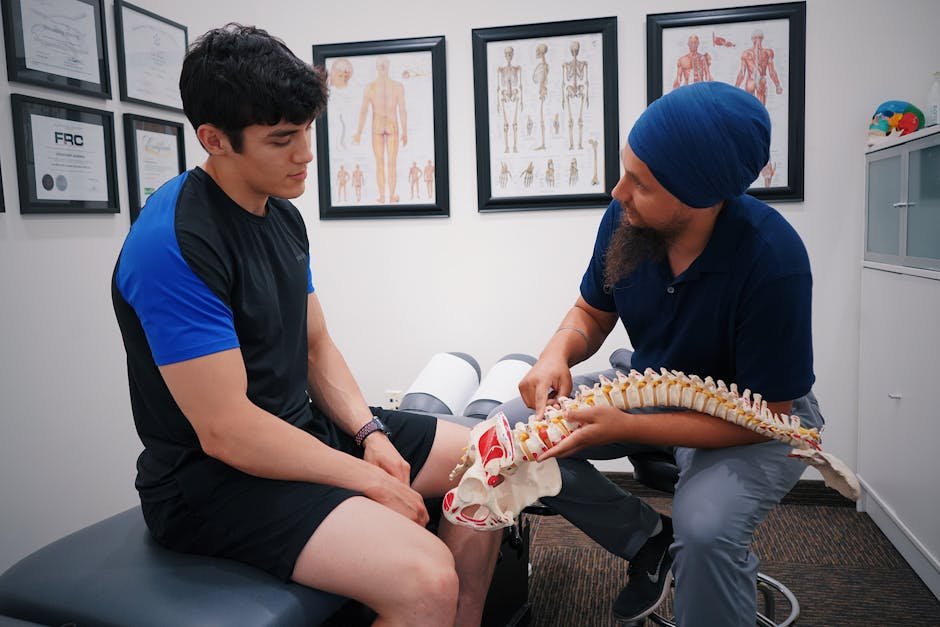
- Seek professional assessment if needed: If you’re experiencing ongoing pain or feel uncertain about where to start, a physical therapist, chiropractor, or movement specialist can assess your kinetic chain, identify where imbalances exist, and guide you with a personalised plan. This is especially worthwhile if you’ve been struggling with back pain that hasn’t responded to other approaches.
Why This “Whole Body” Approach to Spine Health Matters
One of the most common mistakes people make when dealing with back pain is treating the spine in isolation. They stretch their back, apply heat, rest — and wonder why the pain keeps returning. But if the root cause is a mechanical issue further down the chain, treating only the symptom will only ever offer temporary relief. This is why so many people feel stuck in cycles of back pain that never fully resolve.
Shifting your thinking to a whole-body, kinetic chain perspective genuinely changes the game. It opens up new possibilities for finding the real source of discomfort, making more targeted improvements, and building a body that functions with less strain and more ease. It’s not about achieving perfection — our bodies are wonderfully adaptable, and small, consistent improvements in how we move and hold ourselves really do accumulate into big changes over time.
This approach also encourages a more proactive relationship with your body. Rather than waiting for pain to arrive and then scrambling to fix it, you can build habits now that support good mechanics for the long term. Think of it as maintenance for your most important piece of equipment — your body.
It’s also worth celebrating how remarkable your body is. The fact that it compensates so cleverly when something isn’t working quite right is actually a sign of incredible resilience. The goal isn’t to criticise these compensations, but to gently address the underlying causes so your body doesn’t have to work quite so hard to keep you moving comfortably.
Getting Started: Small Steps, Big Impact on Spinal Health
If all of this feels a little overwhelming, take a breath. You don’t need to overhaul your entire lifestyle overnight. The kinetic chain concept is simply a framework for understanding your body better — and the practical steps are straightforward and accessible for most people.
Start by observing. How do your feet feel? Do your hips feel stiff after sitting? Is one side of your body tighter than the other? Awareness itself is a powerful first step. From there, pick one or two small things to work on — maybe adding a short hip stretch in the morning, or taking a short walk at lunchtime. Build gradually, and pay attention to how your body responds.
If you’re unsure whether certain exercises are right for you, or if you’re managing an existing injury or health condition, always check in with a qualified healthcare provider or movement professional before beginning a new routine. They can help you tailor these principles to your specific situation safely and effectively.
The Bottom Line: Lower extremity dysfunction — problems with your feet, ankles, knees, or hips — can have a profound and often overlooked impact on your spinal health and mechanics. Because your body functions as one interconnected kinetic chain, imbalances at the foundation travel upward and can contribute to back pain, stiffness, and poor posture. The encouraging news is that by paying attention to your lower body, improving hip and ankle mobility, strengthening your core and glutes, and choosing supportive footwear, you can make a real difference to how your spine feels and functions. Small, consistent steps add up — and your whole body will thank you for starting from the ground up.
This is not medical advice. Consult your healthcare provider before starting any new health routine or using any product mentioned here.