Improving Balance at Home: Easy Routines Every Senior Can Start Today
This post contains affiliate links. As an Amazon Associate, I earn from qualifying purchases at no extra cost to you.
Free resources — no credit card required for trial
🎧 Listen to health & wellness audiobooks free for 30 days
Start 30-Day Free Trial →
📚 Read unlimited health books free for 30 days
Try Kindle Unlimited Free →
Free resources — no credit card required for trial
🎧 Listen to health & wellness audiobooks free for 30 days
Start 30-Day Free Trial →
🛒 Recommended Products
As an Amazon Associate we earn from qualifying purchases at no extra cost to you.
TheraBand First Step to Active Health Kit — Senior Exercise Program for Balance and Fall P
$19.99
Vitality 4 Life Senior Resistance Band with Instruction Guide — Specifically for Elderly F
$16.99
HONEYBULL Walking Cane for Men and Women — Foldable Adjustable Heavy Duty Free-Standing Al
$34.99
BeneCane Walking Cane Adjustable with Offset Cushioned Handle — Lightweight Mobility Aid f
$29.99
REHAND Walking Cane Foldable Adjustable Collapsible — Heavy Duty All-Terrain with Travel B
$32.99
📚 Read unlimited health books free for 30 days
Try Kindle Unlimited Free →
Think about how many times a day you rely on your balance — stepping out of bed in the morning, reaching for something on a shelf, navigating a step at the front door, or simply standing still while you chat with a neighbour. For many older adults, balance quietly becomes more challenging over time, often without much warning. The reassuring truth? Improving balance doesn’t require a gym membership, expensive equipment, or hours of your day. With simple, consistent at-home routines, you can feel steadier, move more confidently, and protect your independence — starting this week.
Why Balance Changes as We Age (And Why That’s Okay)
Balance is actually a remarkable team effort inside your body. Your muscles, joints, vision, and inner ear all send signals to your brain, helping it understand exactly where your body is in space. When you’re younger, this system hums along without you thinking about it. As the years pass, each part of that team can change slightly — and those small changes can add up to that “wobblier” feeling some seniors notice in daily life.
Leg and hip muscles may not be quite as strong as they once were, making it harder to shift your weight smoothly or stand still without swaying. Your reactions can slow down a little, meaning it takes a moment longer to catch yourself if you stumble. Vision and depth perception changes can make it trickier to judge edges, steps, or uneven ground. Inner-ear changes or occasional dizziness can also briefly throw things off. And then there’s something that doesn’t get talked about enough: the fear of falling. Worry and anxiety can actually cause you to tense up, which ironically makes balance worse rather than better.
The encouraging news is that none of these changes are fixed or final. Research consistently shows that gentle, regular balance training can genuinely improve coordination, muscle strength, and confidence — even for people who haven’t exercised in years. Your body is more adaptable than you might think.
Before You Begin: Setting Yourself Up Safely
Before diving into any new routine, a little preparation goes a long way — especially when it comes to balance work. If you have a history of falls, osteoporosis, recent surgeries, or you take medications that can cause dizziness, it’s worth having a quick chat with your doctor before you start. They can help you understand any modifications you might need and give you the green light to get moving.
Your environment matters just as much as the exercises themselves. Clear a wide, unobstructed space to work in — remove any throw rugs (they’re a genuine trip hazard), make sure the area is well lit, and keep a sturdy chair, kitchen countertop, or solid wall within easy reach. Wear supportive, non-slip shoes rather than socks alone or loose slippers. Avoid wearing wide-legged trousers or long hems that could catch on furniture.
Most importantly, listen to your body throughout. If you feel dizzy, faint, or experience any pain, stop, sit down, and rest. Start slowly, honour your current ability level, and remember: every session, no matter how short, is a positive investment in your health.
A Complete At-Home Balance Routine for Seniors (About 15–20 Minutes)
This routine is designed to be done three times a week, and you can split it into shorter sessions if that feels more manageable. It works through four gentle stages — seated work, standing with support, progressive challenges, and a calming cool-down. Keep your sturdy chair or counter close throughout.
Part 1 — Seated Balance and Ankle Work (3–5 minutes): Start sitting tall in a sturdy chair with your feet flat on the floor. Try slow ankle circles — lift one foot slightly and make 10 circles in each direction, then switch feet. Follow with ankle pumps, pointing your toes away and then pulling them back toward your shin, 15–20 times per foot. Add seated leg extensions (straighten one leg, hold for a count of two, lower it, and repeat 10 times per leg) and gentle toe taps (lift your toes while keeping heels down, then tap the floor). These moves strengthen the small muscles in your feet and ankles that help you sense and adjust to changes in surface — crucial for staying steady on the move.
Part 2 — Standing Balance with Support (6–8 minutes): Move to stand behind your chair or near the counter, hands resting lightly on the support. March gently in place for one to two minutes, lifting your knees slowly and keeping your posture tall. Try a short heel-to-toe walk — just four to six steps, placing one foot directly in front of the other — using your support as needed. Add side leg raises (lift one leg out to the side about six to eight inches, lower slowly, eight to ten reps per leg) and mini squats with support (bend your knees to about 30–45 degrees and rise, eight to twelve times). Finish this section with weight transfer — slowly shifting your weight from one foot to the other, as if stepping between stones, for one to two minutes.
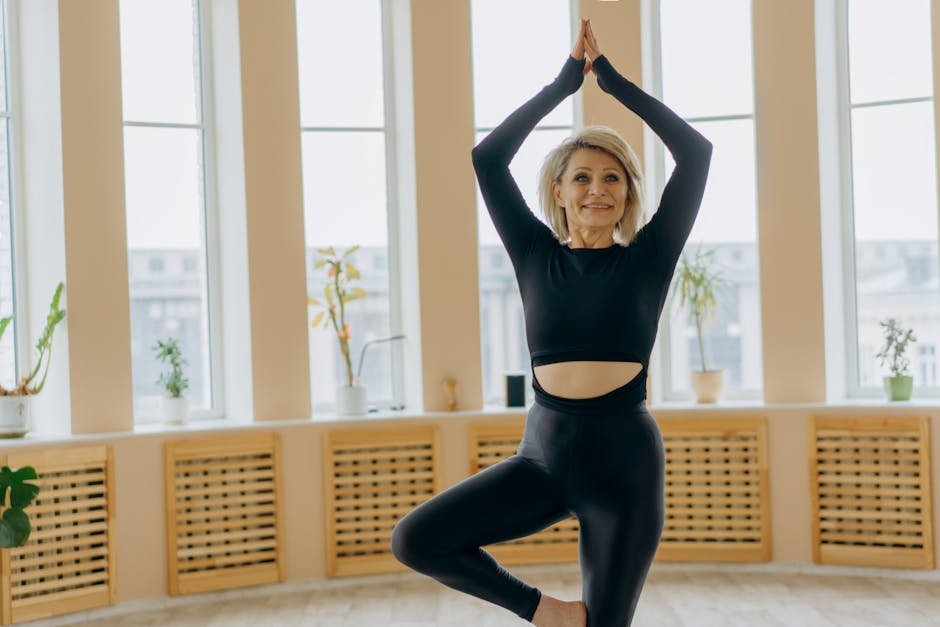
Part 3 — Progressive Challenges (4–6 minutes): This is where you gently push your balance a little further — always with support nearby. Try tandem stance: stand with one foot directly in front of the other, touching the chair lightly, and hold for 15–30 seconds. If you feel steady, experiment with lifting the back foot for five to ten seconds. Try reach-and-reach: stand tall, hold the chair, and reach one hand forward to touch a target on the wall, alternating sides for eight to twelve touches. Or try “clock taps” — imagining a clock face and reaching your hand to the 12, 3, 6, and 9 o’clock positions slowly and deliberately.
Part 4 — Cool-Down and Breathing (2–3 minutes): Finish with slow shoulder rolls, a gentle chin-to-chest neck stretch, and deep breathing. Inhale through your nose for four counts, exhale through your mouth for six counts, and repeat four to six times. This helps calm your nervous system after balance work and leaves you feeling settled rather than stirred up.
What You Can Do: Practical Tips for Staying Consistent
Starting a new routine is one thing — keeping it going is another. The good news is that balance training doesn’t have to feel like a big effort. Small, steady habits are what make the real difference over time. Here are some practical ways to make your balance routine stick:
- Schedule it like an appointment. Pick a regular time — perhaps right after breakfast or just before lunch — and put it in your diary or on a calendar. Treating it as a genuine commitment makes it far easier to follow through.
- Start smaller than you think you need to. If 15 minutes feels daunting, begin with just eight to ten minutes and gradually add a few minutes each week. Building slowly means you’re far less likely to give up.
- Use reminders. Set a gentle alarm on your phone, leave a note on the fridge, or ask a family member to send you a daily message of encouragement. Small nudges make a big difference.
- Sneak balance practice into everyday moments. Stand on one foot while brushing your teeth (near the sink for support), practice weight shifting while you wait for the kettle to boil, or do ankle circles during a TV commercial break.
- Track your progress in a simple way. Keep a small notebook and jot down which exercises felt easier or steadier each week. Seeing your own improvement — even tiny gains — is wonderfully motivating.
- Celebrate every step forward. Did you hold the tandem stance a few seconds longer than last week? Did the heel-to-toe walk feel a little smoother? These are real, meaningful wins worth acknowledging.
Adapting the Routine to Where You Are Right Now
One of the best things about at-home balance routines is that they’re genuinely adaptable. There’s no “one size fits all” — and that’s actually a strength, not a limitation. Whether you’re just starting out or already fairly active, you can shape these exercises to suit your current ability and grow from there.
If you’re new to balance work or feel a little unsure, use your chair or countertop for support through most of the routine. Keep your movements comfortable and within a range that feels stable. There’s no rush to let go of the support — building trust in your body takes time, and that’s completely normal. Focus on the seated exercises and shorter standing bouts until your confidence grows.
If you’re more physically active and want a little more challenge, try increasing the time you hold each stance, extending the number of steps in the heel-to-toe walk, or attempting some of the standing exercises with just a wall nearby rather than hands on a chair. Progress at your own pace and always keep safety your priority.
If you have osteoporosis or a history of fractures, focus on controlled, small movements and avoid deep squats or anything that feels jarring. Good posture and slow, deliberate movement are your best friends. If you’re working with limited space or have a significant fear of falling, do more of the routine seated and gradually introduce short standing bouts as your confidence builds — even a minute of standing practice is progress worth celebrating.
The Bigger Picture: What Better Balance Does for Your Life
Improving balance at home isn’t just about preventing falls (though that’s certainly a hugely important benefit). The ripple effects reach further than most people expect. Physically, better balance means easier transfers from sitting to standing, safer use of stairs, and more stable, comfortable walking — all of which contribute directly to your day-to-day independence.
There are mental and emotional benefits too. Paying close attention to balance exercises — focusing on where your body is in space, moving deliberately, staying present — can actually help sharpen focus and mental alertness, supporting your broader daily activities. Many people find that regular balance practice improves their mood, their sleep quality, and their general sense of wellbeing.
Perhaps most meaningfully, feeling steadier on your feet reduces the fear of falling. And when that fear diminishes, something wonderful happens: people re-engage with the things they love. They accept the invitation to a friend’s gathering. They feel comfortable taking that walk to the local shops. They reach for things on shelves without hesitating. Confidence in your body opens doors — and that’s worth every minute of practice.
Progress in balance happens gradually, and it rarely announces itself dramatically. You may simply notice one day that you stepped off a kerb without thinking twice, or that you stood up from the sofa without needing to brace yourself quite so much. These quiet improvements are real, and they matter enormously. If at any point you’d like more personalised guidance, a physical therapist or your GP can help you tailor movements to your specific needs — and there’s absolutely no shame in asking for that support.
The Bottom Line: Improving balance at home is one of the most practical, accessible things a senior can do for their long-term health and independence. With just three sessions a week, a clear space, a sturdy chair, and a willingness to start small, you can build genuinely steadier movement, stronger muscles, and real confidence in your body. The routines outlined here are gentle, safe, and designed to grow with you — so wherever you’re starting from, there’s a version of this that works for you. Be patient with yourself, celebrate every small gain, and trust that consistent effort adds up to meaningful change over time.
This is not medical advice. Consult your healthcare provider before starting any new health routine or using any product mentioned here.