Yoga Warm-Up Routine for Seniors: A Gentle Daily Start for Flexibility, Balance, and Wellbeing
This post contains affiliate links. As an Amazon Associate, I earn from qualifying purchases at no extra cost to you.
Free resources — no credit card required for trial
🎧 Listen to health & wellness audiobooks free for 30 days
Start 30-Day Free Trial →
🛒 Recommended Products
As an Amazon Associate we earn from qualifying purchases at no extra cost to you.
TheraBand First Step to Active Health Kit — Senior Exercise Program for Balance and Fall P
$19.99
EZ Off Jar Opener for Seniors — Under Cabinet Jar Opener for Weak Hands and Arthritis
$9.99
Omron 5 Series Upper Arm Blood Pressure Monitor — 2-User 100-Reading Memory Wide-Range Cuf
$44.99
OMRON 7 Series Wireless Wrist Blood Pressure Monitor — Clinically Validated with Connect A
$69.99
Vitality 4 Life Senior Resistance Band with Instruction Guide — Specifically for Elderly F
$16.99
📚 Read unlimited health books free for 30 days
Try Kindle Unlimited Free →
If you’ve ever rolled out of bed in the morning feeling like your joints need a little convincing, you’re not alone. Stiffness, creaky knees, and tight shoulders are a very common part of life for many of us as we get older — but they don’t have to be the whole story. A simple, gentle yoga warm-up routine for seniors can make a remarkable difference in how your body feels, moves, and holds itself throughout the day. You don’t need to be flexible, fit, or experienced with yoga to benefit. All you need is a sturdy chair, a few quiet minutes, and the willingness to show up for yourself.
Why a Yoga Warm-Up Routine for Seniors Is So Important
Think of your body first thing in the morning — or after a long stretch of sitting — like a car engine on a cold day. It works best when it’s been given a few minutes to warm up before you push it hard. For seniors especially, jumping straight into activity without a proper warm-up increases the risk of muscle strain, joint discomfort, and loss of balance. A good warm-up invites your body to wake up gradually, safely, and kindly.
Warming up increases blood flow to your muscles and joints, which makes movement feel easier and more fluid. It also helps reduce stiffness that can build up overnight or during periods of rest. Perhaps most importantly, it trains your body awareness — that quiet sense of where you are in space — which is one of the key foundations of good balance and fall prevention. When you take just 8 to 12 minutes to warm up with gentle yoga-inspired movements, you’re not just preparing for exercise. You’re investing in your long-term confidence, mobility, and wellbeing.
The good news? This kind of routine is highly adaptable. Whether you’re seated in a chair, standing by a wall, or somewhere in between, there’s a version of each movement that works for you. The goal is never perfection — it’s gentle, consistent progress.
What You’ll Need Before You Begin
One of the best things about a senior yoga warm-up routine is that it requires very little equipment. You’ll want a sturdy chair with a back — something solid that won’t slide or wobble when you rest a hand on it. A wall or kitchen counter works just as well for balance support. Wear comfortable, non-slip clothing and footwear, and keep a glass of water nearby. Optionally, a light yoga strap or even a fabric belt can be handy for some gentle stretches, but it’s absolutely not essential.
Before you start, a few golden rules: move slowly, breathe gently, and never force or bounce through a movement. Keep everything within a comfortable range of motion. If you have conditions like arthritis, osteoporosis, or any heart concerns, it’s worth checking in with your doctor or physiotherapist before beginning — just to make sure this kind of gentle movement is right for you. And if at any point you feel sharp pain, dizziness, or any unusual sensation, stop, rest, and take stock.
Your Step-by-Step Gentle Yoga Warm-Up Routine
This full routine takes around 8 to 12 minutes and covers your whole body from head to toe — neck, shoulders, spine, hips, and feet. Here’s how to move through it.
Start with seated breathing and posture (about 1 minute). Sit tall in your chair with feet flat on the floor and knees aligned over your ankles. Rest your hands on your thighs or lightly on your belly. Inhale slowly through your nose for a count of four, letting your belly gently rise. Exhale for a count of six. With each breath, imagine your spine growing a little taller and your shoulders melting downward. This breathing exercise brings fresh oxygen to your muscles and calms your nervous system before movement begins.
Move into neck loosening (1 minute). Gently tilt your head toward your right shoulder and hold for one breath, then return to centre and repeat on the left. Follow this with small, slow head circles — forward, to the right, back, and to the left. Keep the movements gentle and stay within what feels comfortable. Neck stiffness is incredibly common from daily activities like reading or screen time, so this simple release is more valuable than it might seem.
Shoulder shrugs and rolls (1 minute). Inhale and lift your shoulders toward your ears, then exhale and let them drop. Do five or six of these. Then roll your shoulders in slow, easy circles — up, back, and down. Repeat in the other direction. Looser shoulders ease tension in your neck and upper back, which has a direct positive effect on your posture and energy levels.
Arm circles and a gentle chest opener (1 minute). Extend your arms out to your sides and make small circles forward for about 20 seconds, then backward. If you like, hold the back of a chair with both hands, walk your feet back slightly, and gently pull your chest forward for a mild chest stretch. Keep your spine long throughout. This opens up the chest and shoulders, which so often become rounded and tight from sitting.
Gentle side stretches (1 minute). Reach one arm overhead while the other rests on your hip or a chair. Tip your torso gently to the opposite side and hold for a breath, then rise back to centre. Repeat on the other side. If raising your arm feels uncomfortable, a small sideways lean is equally effective. This wakes up the sides of your trunk, which supports bending, walking, and everyday movement.
Seated Cat-Cow spinal warm-up (1 to 2 minutes). Place your hands on your thighs. As you inhale, gently arch your spine, lift your chest, and look forward — this is Cow. As you exhale, round your spine and tuck your chin toward your chest — this is Cat. Move slowly and gently between the two for six to eight cycles. This beloved yoga sequence wakes up the entire spine and encourages healthy, flexible posture.
Seated hip opener (1 to 2 minutes). Cross one ankle gently over the opposite knee and press the raised knee softly downward with your hand for a mild hip stretch. Hold for a breath or two, then switch sides. If this is uncomfortable, keep both feet flat on the floor and gently rock your knees side to side instead. Warm, mobile hips are essential for walking, balance, and ease of daily movement.
Ankle and foot activation (1 minute). Point and flex your toes several times. Circle your ankles slowly in each direction. Then try gently tapping your toes on the floor and, if it feels safe, lift your heels for small heel raises. These movements warm up the joints of the feet and ankles — often overlooked, but crucial for balance and stability.
Standing balance preparation (1 to 2 minutes). If you’re able to stand, position yourself beside a chair or wall and practice a gentle march in place, or rock your weight softly from side to side. Keep your knees slightly soft and your spine tall. Even this brief standing practice builds the stability your body needs for daily tasks like rising from a chair, turning, and walking safely.
Finish with a full-body stretch and breath check (1 minute). Reach both arms overhead as you inhale, then slowly lower them as you exhale. Finish with a few slow, deep breaths and simply notice how your body feels. You’ve done something genuinely good for yourself.
What You Can Do: Practical Tips for Making This Routine Stick
- Start small. Even five minutes of this warm-up is better than none. On busy or low-energy days, do a shortened version rather than skipping it entirely.
- Choose a regular time. Morning is ideal for loosening overnight stiffness, but just before a walk or any physical activity works beautifully too.
- Keep your chair nearby. Having your “warm-up chair” in a familiar spot removes the friction of getting started.
- Use support without hesitation. A chair, wall, or countertop is not a sign of limitation — it’s smart, safe practice.
- Aim for 3 to 5 days a week. Consistency is what builds real improvement in flexibility, balance, and confidence over time.
- Pair it with something enjoyable. Do your warm-up while listening to your favourite music or a podcast to make it feel like a treat rather than a chore.
- Progress gradually. Over days and weeks, you may find your range of motion naturally increases. Let that happen gently, without forcing it.
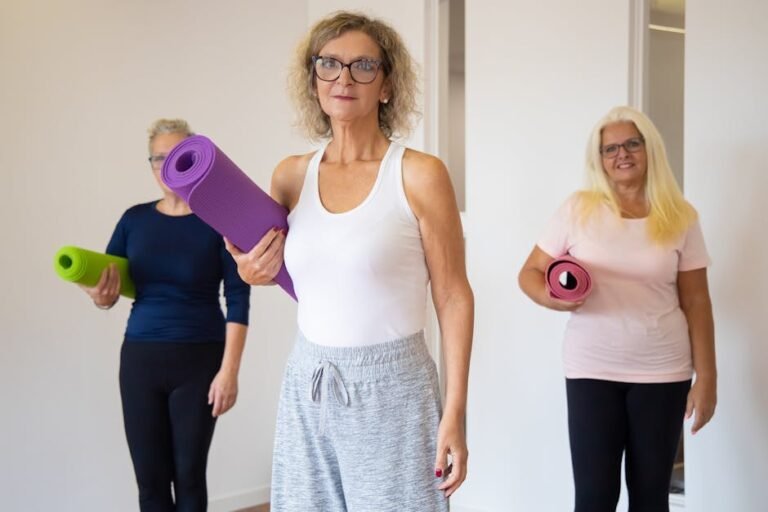
- Consider a non-slip yoga mat for extra stability if you’re doing any standing movements. Look for one with a high-grip surface designed for gentler styles of movement.
The Real Benefits of a Consistent Senior Yoga Warm-Up
The benefits of a regular yoga warm-up routine go well beyond the physical. Yes, you’ll likely notice that your joints feel less stiff, your movements feel smoother, and your posture improves over time. But many people who commit to a daily warm-up practice also notice something quieter and perhaps even more valuable: they feel more centred, calmer, and more at home in their bodies.
Physically, the routine helps increase blood flow to your muscles and joints, which reduces the effort required to move and lowers the risk of strain. Warmed-up joints are better protected than cold ones, and improved balance awareness directly supports safety in daily life — reducing the risk of trips and falls. Your gait and walking confidence can improve, and general fatigue during daily activities often decreases.
There’s also something to be said for the habit itself. Showing up for your body each day — even gently, even briefly — builds a relationship of care and trust with yourself. Over time, that consistency becomes its own kind of strength.
Listening to Your Body: The Most Important Part of Any Warm-Up
No warm-up routine, however well-designed, is more important than your comfort and safety. The guiding principle throughout every step of this yoga warm-up for seniors is this: a gentle stretch is welcome; pain is not. If you feel sharp or intense discomfort at any point, stop immediately, rest, and try a smaller, lighter version of the movement — or simply skip it for that day.
Pay attention to your breathing throughout. Steady, relaxed breath is a sign your body is comfortable. If you notice your breath shortening, quickening, or if you feel lightheaded, slow down or pause for a moment. Your body communicates clearly — this routine is about learning to listen to it with patience and kindness.
Remember, too, that everybody is different. Two people of the same age can have very different levels of flexibility, strength, and balance. There is no “right” way to look doing these movements. The right way is your way — adapted, supported, and paced to suit exactly where you are today. And where you are today is exactly good enough.
The Bottom Line: A gentle yoga warm-up routine for seniors is one of the most accessible, effective things you can do for your daily health and wellbeing. By spending just 8 to 12 minutes waking up your joints, loosening your muscles, and connecting with your breath, you’re giving your body the care it deserves. Done consistently over time, this kind of routine can bring real improvements in flexibility, balance, posture, and overall confidence — helping you move through each day with greater ease and joy. Start gently, be patient with yourself, and enjoy the process.
This is not medical advice. Consult your healthcare provider before starting any new health routine or using any product mentioned here.