Movements to Maintain Mobility After 65: Your Complete Guide to Staying Active and Independent
This post contains affiliate links. As an Amazon Associate, I earn from qualifying purchases at no extra cost to you.
Free resources — no credit card required for trial
🎧 Listen to health & wellness audiobooks free for 30 days
Start 30-Day Free Trial →
🛒 Recommended Products
As an Amazon Associate we earn from qualifying purchases at no extra cost to you.
TheraBand First Step to Active Health Kit — Senior Exercise Program for Balance and Fall P
$19.99
EZ Off Jar Opener for Seniors — Under Cabinet Jar Opener for Weak Hands and Arthritis
$9.99
Omron 5 Series Upper Arm Blood Pressure Monitor — 2-User 100-Reading Memory Wide-Range Cuf
$44.99
OMRON 7 Series Wireless Wrist Blood Pressure Monitor — Clinically Validated with Connect A
$69.99
Vitality 4 Life Senior Resistance Band with Instruction Guide — Specifically for Elderly F
$16.99
📚 Read unlimited health books free for 30 days
Try Kindle Unlimited Free →
If you’re over 65 and want to keep doing the things you love — walking the dog, playing with grandchildren, or simply getting up from your favourite chair with ease — then maintaining your mobility is one of the best investments you can make in yourself. The great news is that you don’t need a gym membership, expensive equipment, or hours of your day. A small, steady routine of simple movements to maintain mobility after 65 can make a genuinely meaningful difference to your strength, balance, and confidence. In this post, we’ll walk you through safe, practical exercises that suit a wide range of ability levels, along with tips to help you build a routine that actually sticks.
Why Mobility Matters More Than Ever After 65
Mobility is about so much more than exercise — it’s about freedom. Being able to walk to the letterbox, climb a flight of stairs, bend down to pick something up, or get in and out of a car without assistance are all acts of independence that most of us take for granted until they become a little harder. As we age, muscle mass naturally declines and balance can become less reliable, which is why falls are one of the leading concerns for older adults. But here’s the encouraging part: these changes are not inevitable, and they’re certainly not irreversible.
Regular movement — even gentle, short bursts of it — helps preserve the muscle strength and joint flexibility that keep everyday life running smoothly. Research consistently shows that staying active as we age reduces fall risk, supports better posture, eases joint stiffness, and even improves mood. You don’t need to become an athlete. You just need to move a little, consistently, and with intention. That’s exactly what the movements in this guide are designed to help you do.
Simple Leg and Lower Body Movements to Maintain Mobility After 65
Your legs do the heavy lifting when it comes to daily independence. Strengthening them — even gently — can transform how you move through your day. Here are three foundational lower body movements that are safe, effective, and easy to adapt to your current level.
Chair Stand (Sit-to-Stand): This is one of the most practical exercises you can do, because it mirrors exactly what you do dozens of times each day. Sit toward the front edge of a sturdy chair with your feet hip-width apart. Keep your back tall, press through your heels, and rise to standing slowly. Then lower yourself back down with control. Start with 5–8 repetitions. If you need a little help at first, use your arms to push off — there’s absolutely no shame in that. As you get stronger, try pausing at the top for a couple of seconds before sitting back down.
Step-Ups: Standing in front of a low, stable step or stair, place one foot fully on the step and bring the other foot up to meet it, then step back down. Use a railing or wall for support as needed. This movement builds leg strength and gives you genuine confidence on stairs and kerbs. Start with 6–8 steps per side. If a full step feels too much at first, simply tapping your foot up onto the step and back down is a perfectly valid starting point.
Calf Raises: Stand tall behind a sturdy chair, holding the back for balance. Slowly rise up onto the balls of your feet, then lower your heels back down. This one is deceptively powerful — strong calves support stable walking and better balance on uneven surfaces. Keep your knees soft, not locked, and move at a slow, controlled pace. If you have any ankle discomfort, you can do these seated by simply lifting your heels off the floor while sitting in a chair.
Balance and Coordination Exercises That Build Confidence
Balance is a skill — and like any skill, it improves with practice. Many falls happen not because someone is frail, but because their balance hasn’t been challenged in a while. Adding a few minutes of balance work to your routine each week can make a surprisingly big difference to how steady and confident you feel on your feet.
Heel-to-Toe Walk (Tandem Walking): Find a clear hallway or corridor and walk with the heel of one foot placed directly in front of the toes of the other, as if you’re walking along a tightrope. Keep your eyes forward and stay close to a wall for support. Aim for 10–20 steps, then rest. This exercise improves coordination and trains the balance systems your body uses during everyday walking. If the full movement feels wobbly, slow it right down or use a line on the floor as a visual guide.
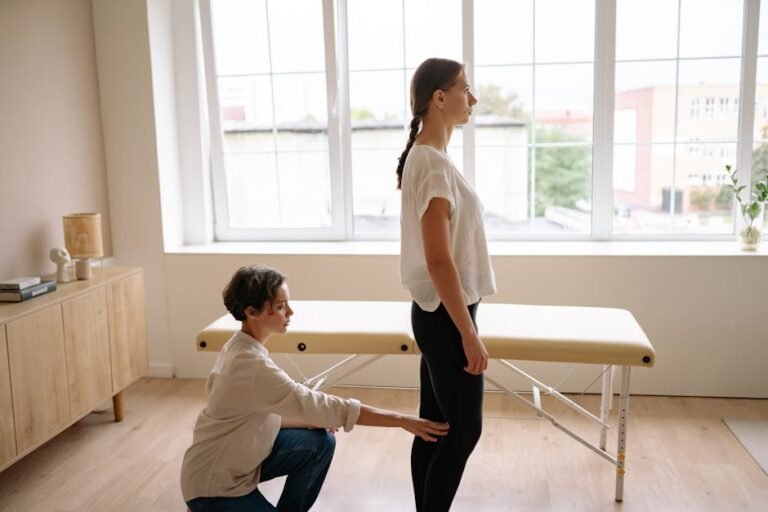
Single-Leg Balance Practice: Stand with your back close to a wall or chair. Shift your weight onto one foot and lift the other foot slightly off the ground. Hold for 10–20 seconds, then switch sides. It sounds simple, but even this small challenge sends important signals to your nervous system and strengthens the stabilising muscles around your ankles and hips. Always keep something within grabbing distance, especially when you’re just starting out.
Upper Body and Core Movements for Everyday Strength
We often focus on legs when we talk about mobility, but upper body and core strength matter enormously too. Think about pushing open a heavy door, lifting a bag of shopping, or pushing yourself up from a low sofa. These actions rely on a functional upper body, and keeping those muscles strong makes daily life genuinely easier.
Wall Push-Ups: Stand a short step away from a wall, with your hands placed at shoulder height and shoulder-width apart. Bend your elbows to bring your chest toward the wall, then push back. Keep your body in a straight line from head to heels and engage your core lightly. Wall push-ups are a gentle but effective way to build upper body strength without putting any strain on your wrists, shoulders, or knees. As you grow stronger, you can move your feet a little further back to increase the challenge.
Glute Bridge: Lie on your back with your knees bent and feet flat on the floor, hip-width apart. Press through your heels to lift your hips toward the ceiling, forming a straight line from your shoulders to your knees. Hold briefly, then lower slowly. This movement strengthens the glutes and supports a stable pelvis — both of which are crucial for getting out of chairs, climbing stairs, and protecting your lower back. Start with 6–8 repetitions. If lying on the floor is uncomfortable, speak to a physiotherapist about chair-based alternatives.
Seated Moves and Ankle Mobility for Circulation and Flexibility
Not every exercise has to be standing. Seated movements are wonderfully effective, especially on days when energy is low or you’re easing back in after a rest period. They’re also ideal for improving circulation and reducing that morning stiffness that so many people over 65 experience.
Seated Leg Extensions: Sitting tall in your chair, extend one leg straight out in front of you and hold for a few seconds before lowering it. Switch legs and repeat. This gently strengthens the quadriceps — the muscles at the front of your thighs — which are essential for standing and walking.
Ankle Circles and Pumps: Lift one foot slightly off the floor and rotate your ankle slowly in circles, first in one direction and then the other. Then try ankle pumps — point your toes away from you, then flex your foot back toward you, as if you’re pressing and releasing a gentle pedal. Do several repetitions on each side. These moves are excellent for improving ankle mobility and encouraging healthy circulation in the lower legs, particularly if you spend time sitting.
What You Can Do: Practical Tips for Building Your Mobility Routine
Knowing the exercises is one thing — building a routine that actually fits into your life is another. Here are some practical, realistic tips to help you get started and keep going:
- Start with a 5-minute warm-up: Before your exercises, spend a few minutes doing gentle marching on the spot, shoulder rolls, and soft neck movements. This warms up your muscles and reduces the risk of discomfort.
- Aim for 3–5 short sessions per week: You don’t need to exercise every day, and you don’t need long sessions. Even 10–20 minutes, three to five times a week, adds up to meaningful progress over time.
- Wear supportive shoes: Even indoors, a pair of well-fitting, non-slip shoes or trainers provides better stability than socks or slippers during exercise.
- Clear your space: Before you begin, make sure the area around you is free of rugs, clutter, or anything you could trip over. Keep a sturdy chair or wall within easy reach.
- Listen to your body: Mild muscle tiredness the day after exercise is normal and a sign your body is responding. But sharp pain, dizziness, or chest discomfort means stop immediately and rest. When in doubt, check in with your doctor.
- Progress gradually: Small, consistent steps will always beat trying to do too much too soon. Add one extra repetition, or an extra few seconds of balance hold, and celebrate that progress — it matters.
- Consider a resistance band or non-slip mat: These are inexpensive tools that can add variety to your routine. A light resistance band can gently increase the challenge of leg exercises, and a non-slip mat gives you a stable surface for floor work.
- If you have a health condition: Talk to your GP or physiotherapist before starting any new exercise routine, especially if you have osteoporosis, joint replacements, heart conditions, or recent surgery.
Staying Consistent: The Real Secret to Lasting Mobility
Here’s the truth that no exercise guide can afford to leave out: consistency beats perfection every single time. You don’t need to do every exercise in this list every day. You don’t need to have flawless form from day one. What matters is showing up regularly — even on days when motivation is low, even when you only have ten minutes, even when you start with just three repetitions of one exercise. That’s still movement, and movement is always better than none.
The real gains from a mobility routine build quietly over weeks and months. One day you’ll notice that getting up from the sofa feels easier. Or that you climbed a flight of stairs without needing to pause. Or that you walked around the shops without your legs feeling tired. These are the victories that matter — not numbers on a scale or seconds on a stopwatch, but the practical, everyday freedoms that make life richer and more enjoyable.
It helps to attach your exercises to something you already do. Maybe you do your calf raises while the kettle boils. Maybe you practise your chair stands during an ad break. Maybe heel-to-toe walking becomes part of your trip down the hallway to the bathroom. Small habits attached to existing routines are far easier to maintain than formal “workout sessions” that require a lot of mental effort to begin.
The Bottom Line: Maintaining mobility after 65 is not only possible — it’s genuinely within reach for most people, regardless of current fitness level. The movements outlined here — chair stands, step-ups, calf raises, heel-to-toe walking, glute bridges, wall push-ups, balance practice, and seated ankle work — are simple, safe, and adaptable. Start slowly, be kind to yourself, warm up first, and build up gradually. With regular practice, you’ll likely find that everyday tasks feel a little lighter, your balance feels a little steadier, and your confidence grows with every week. You deserve to move with ease and live with independence — and the steps to get there are smaller than you might think.
This is not medical advice. Consult your healthcare provider before starting any new health routine or using any product mentioned here.