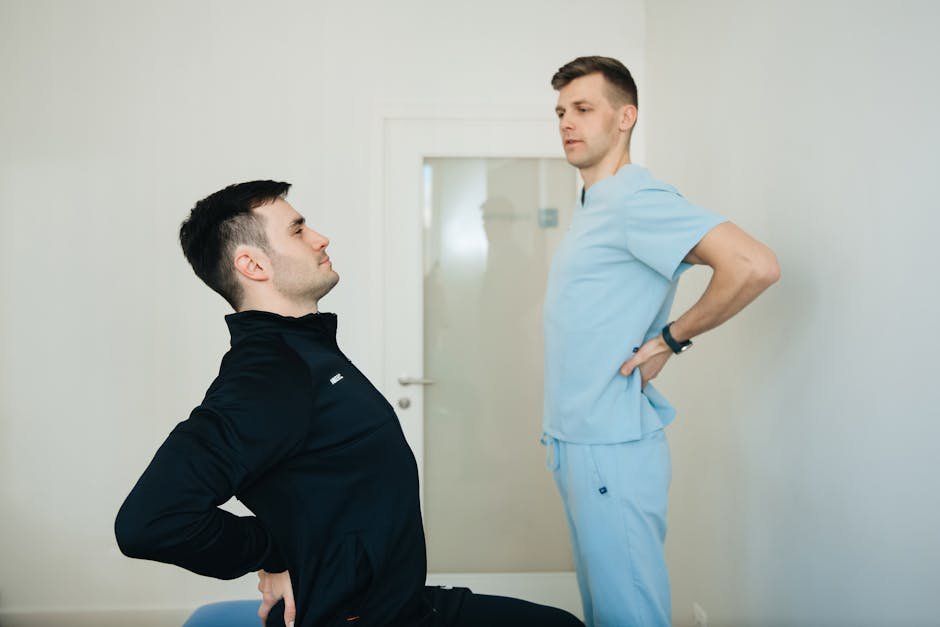
Forward Head Posture and Postural Deviations: What They’re Really Doing to Your Spine
This post contains affiliate links. As an Amazon Associate, I earn from qualifying purchases at no extra cost to you.
Free resources — no credit card required for trial
🎧 Listen to health & wellness audiobooks free for 30 days
Start 30-Day Free Trial →
🛒 Recommended Products
As an Amazon Associate we earn from qualifying purchases at no extra cost to you.
TruContour Lumbar Pillow for Sleeping — Adjustable Height Lower Back Support
$39.99
BestOffice Ergonomic Mesh Desk Chair with Lumbar Support — Adjustable Rolling Swivel Chair
$69.99
Branfit Shoulder and Back Brace Posture Corrector — Breathable Posture Trainer for Upper B
$24.99
Posture Corrector for Women and Men — Comfortable Effective Brace for Shoulder and Back Pa
$22.99
Bodywellness Posture Corrector for Men and Women — Adjustable Back Straightener with Clavi
$19.99
📚 Read unlimited health books free for 30 days
Try Kindle Unlimited Free →
That nagging ache in your neck, the stiffness creeping into your shoulders after a long day at your desk, the dull throb in your lower back that just won’t quit — sound familiar? Most of us have been there, and most of us chalk it up to stress, getting older, or simply bad luck. But here’s something worth knowing: a huge part of what’s driving that discomfort could be something you’re doing (or not doing) every single waking moment. Your posture — and in particular, common postural deviations like forward head posture — can have a profound, wide-reaching impact on your spinal health, your energy levels, and even your mood. The good news? Once you understand what’s going on, you can start doing something about it.
Your Spine Is a Masterpiece — And Posture Is How You Protect It
Before diving into what goes wrong with poor posture, it helps to appreciate just how brilliantly your spine is designed. It’s not simply a stack of bones holding you upright. Your spine is a sophisticated, flexible pillar that provides structural support, enables an incredible range of movement, and shields your spinal cord — the critical communication highway running signals between your brain and every part of your body.
For your spine to do all of this well, it depends on what’s known as “optimal posture.” That doesn’t mean standing stiff as a soldier at attention. It means maintaining a balanced, efficient alignment where your brain, muscles, and skeleton all work together smoothly and without unnecessary strain. Hundreds of muscles are involved in this process at any one time, constantly making tiny adjustments to keep your joints stable whether you’re walking, sitting, or reaching overhead.
Central to your spine’s clever design are its three natural curves: a gentle inward curve in your neck (cervical lordosis), a slight outward curve in your upper back (thoracic kyphosis), and another inward curve in your lower back (lumbar lordosis). Think of these curves like a series of springs working together. They’re not just aesthetic features — they’re functional necessities. These curves allow your spine to absorb shock, distribute the loads placed on your body, and support efficient movement. In fact, this curved “S” shape allows your spine to withstand forces up to ten times greater than a perfectly straight column ever could. That’s extraordinary engineering, and your posture is what keeps that engineering working as intended.
How Modern Life Creates Postural Deviations Like Forward Head Posture
Here’s the uncomfortable truth: our modern lifestyles are not doing our spines any favours. We spend hours bent over laptops, scrolling through phones, hunching at desks, and sinking into soft sofas. These sedentary, screen-heavy habits have created what many health experts now call an “epidemic of postural dysfunction” — and it’s affecting people of all ages.
One of the most common and damaging examples is forward head posture (FHP). Take a moment and notice where your head is right now as you read this. Is it jutting forward, chin angled slightly down, shoulders rounding inward? If so, you’re experiencing FHP firsthand. Here’s why that matters: for every inch your head moves forward of its natural alignment over your shoulders, the effective weight your neck muscles must support roughly doubles. A head that weighs around 10–12 pounds starts to feel more like 20, 30, or even 40 pounds on your cervical spine. It’s the difference between carrying a bowling ball close to your chest versus holding it at arm’s length — same ball, dramatically more effort and strain.
Another common deviation is excessive thoracic kyphosis, or a rounded, hunched upper back. This often develops alongside FHP and is worsened by shortened chest muscles and weakened upper back muscles. When your upper back rounds too much, your neck tends to lose its healthy inward curve, and your lower back may either flatten out or overarch to compensate. These shifts in your natural spinal curves set off what’s known as a “kinetic chain” reaction — a cascade where one misalignment causes other parts of the body to compensate, creating new problems elsewhere. Your lower back might arch more to balance your forward head. Your hips may tilt. Your knees might shift. What starts as a small postural habit slowly reshapes how your entire body moves and feels.
The Real Consequences of Poor Posture on Your Spinal Health
Postural deviations aren’t just about aesthetics or the occasional twinge of discomfort. Over time, chronic poor posture can quietly erode your quality of life in ways that go much further than a sore neck. Understanding the full picture is genuinely motivating — because it shows just how much is at stake and how much you stand to gain by making changes.
Persistent pain is the most obvious consequence. Neck pain, upper and lower back pain, shoulder discomfort, and even frequent headaches are all commonly linked to postural dysfunction. When your body is out of alignment, certain muscles are forced to work overtime, others become chronically shortened and tight, and joints that weren’t designed to bear certain loads end up doing exactly that. The result is pain that can range from annoying to genuinely debilitating.
There are less obvious consequences too. Chronic poor posture can reduce your mobility and flexibility as tight muscles and weakened stabilisers limit your range of motion. It can increase your risk of injury, because misaligned joints and overstressed tissues are more vulnerable to strains, sprains, and longer-term degenerative changes. Perhaps most surprisingly, a rounded upper back can actually compress your chest cavity, limiting your diaphragm’s ability to expand fully and potentially reducing your lung capacity — meaning poor posture can affect how well you breathe. And research has even linked posture to psychological wellbeing: standing tall is associated with greater feelings of confidence and energy, while a slumped posture can contribute to low mood and fatigue. These aren’t trivial effects. They touch almost every dimension of how you feel day to day.
Why Simply “Sitting Up Straight” Isn’t the Whole Answer
If you’ve ever been told to just pull your shoulders back and stand up straighter, you’ve probably noticed that the effect doesn’t last long. That’s because postural correction is genuinely more complex than adjusting your position for a few minutes. To make lasting change, you need to address several layers of the problem at once.
First, there are muscle imbalances. Poor posture almost always involves muscles that are too tight in some areas and too weak in others. Your chest and front-of-neck muscles may be chronically shortened from hours of screen time, while your upper back, deep neck flexors, and core muscles have become underactive. Simply telling tight muscles to “hold a different position” without addressing these imbalances is a bit like trying to straighten a bent fence post by leaning on it — it will spring back the moment you stop.
Second, there are deeply ingrained movement patterns. Your nervous system learns the positions and movements you repeat most often and starts to treat them as “normal.” Retraining these patterns takes time, consistency, and often some professional guidance. This is why physiotherapists and chiropractors don’t just give you a single exercise — they work with you to systematically retrain your body’s understanding of what balanced alignment feels like. Lasting postural correction is a process, not a one-time fix, and that’s perfectly okay.
What You Can Do: Practical Tips for Better Posture and Spinal Health
Here’s the genuinely encouraging part: your posture is not fixed. Your body is remarkably adaptable, and with consistent effort and some smart strategies, meaningful improvement is absolutely achievable. You don’t need to overhaul your entire life overnight — small, sustainable changes add up to significant results over time.
- Build body awareness throughout your day. Set a reminder on your phone every hour to do a quick posture check. Is your head drifting forward? Are your shoulders rounding? Are you slouching in your chair? You can’t change what you don’t notice, and consistent check-ins are a powerful first step.
- Optimise your workspace ergonomics. If you work at a desk, make sure your feet are flat on the floor, your knees are at roughly a 90-degree angle, and your hips are slightly higher than your knees. Your monitor should be at eye level and about an arm’s length away, so your head isn’t perpetually dropping forward or tilting up. Wrists should be neutral when typing — not bent upward or downward.
- Break up prolonged sitting every 30–60 minutes. Get up, walk around, shake out your limbs. Even a two-minute movement break can interrupt the pattern of stiffness and muscular fatigue that builds during long static positions.
- Strengthen your core and back muscles. Your core acts like a natural internal corset for your spine. Exercises like planks, bird-dogs, and gentle back extensions can build the deep stability muscles that support good posture from the inside out. If you’re new to these movements, a fitness professional can help you start safely.
- Stretch the areas that tighten most. Pay particular attention to your chest muscles, hip flexors (especially if you sit a lot), and the front of your neck. These tend to become chronically shortened with modern posture habits and need regular attention to stay flexible.
- Consider supportive tools mindfully. Ergonomic chairs, lumbar support cushions, and posture reminder devices can all be helpful — but they work best as part of a broader strategy, not as a substitute for building strength and awareness.
- Seek professional support if you’re struggling. If you’re dealing with chronic pain or find your posture isn’t improving despite your efforts, a physiotherapist, chiropractor, or qualified movement specialist can assess your specific patterns, identify what’s driving the problem, and give you a personalised plan.
None of these steps require a major life overhaul. They just require a little consistent attention — and the understanding that every small effort you make is genuinely protecting your long-term spinal health.
The Bigger Picture: Postural Health as an Investment in Your Wellbeing
It can be easy to treat postural discomfort as something to endure rather than address — just another background noise in a busy life. But the science is clear that postural deviations like forward head posture and excessive spinal curvature changes are not trivial. Left unaddressed, they can quietly chip away at your mobility, your comfort, your breathing, your energy, and your overall quality of life over months and years.
The encouraging flip side is that because posture is largely a product of habits — habits of movement, position, and muscle use — it’s also something you genuinely have the power to influence. Your spine was designed to be resilient and adaptable. Given the right conditions, the right support, and a little consistent effort, it can and does respond. People who commit to postural correction routinely report not just reduced pain, but better energy, improved breathing, greater confidence, and a renewed sense of ease in their bodies.
Think of improving your posture not as a chore or a correction, but as one of the most worthwhile long-term investments you can make in how you feel every single day. Start small, be patient with yourself, and don’t hesitate to ask for help when you need it. Your spine has been working hard for you — it’s worth returning the favour.
The Bottom Line: Postural deviations like forward head posture and rounded upper back are far more than cosmetic concerns — they place real, measurable strain on your spinal mechanics, contribute to chronic pain, reduce mobility, affect breathing, and even influence your mood and energy. The good news is that posture is a habit, and habits can change. By building body awareness, optimising your workspace, moving regularly, strengthening your core, stretching tight areas, and seeking professional guidance when needed, you can genuinely protect and improve your spinal health at any age. Small, consistent steps really do make a lasting difference.
This is not medical advice. Consult your healthcare provider before starting any new health routine or using any product mentioned here.