
The Kinetic Chain and Your Spine: How Every Part of Your Body Is Connected
This post contains affiliate links. As an Amazon Associate, I earn from qualifying purchases at no extra cost to you.
Free resources — no credit card required for trial
🎧 Listen to health & wellness audiobooks free for 30 days
Start 30-Day Free Trial →
📚 Read unlimited health books free for 30 days
Try Kindle Unlimited Free →
Have you ever woken up with a stiff neck you just can’t explain, or felt that nagging twinge in your lower back despite not doing anything obviously strenuous? You’re not alone — and the reason might surprise you. For decades, we’ve been taught to treat pain in isolation: a sore shoulder is just a shoulder problem, back pain is just a back problem. But modern understanding of spinal biomechanics tells a very different, and much more empowering, story. Your spine isn’t just a stack of bones — it’s the backbone (literally) of a magnificent, fully connected movement system called the kinetic chain. Understanding how this chain works could be the key to finally making sense of your pain, moving with more ease, and taking better care of your body for the long haul.
What Is the Kinetic Chain — and Why Should You Care?
Picture a bicycle chain. When one link moves, every other link responds. Power flows from the pedals, through the chain, all the way to the wheel. Your body works in a strikingly similar way. The concept of the kinetic chain was first described by an engineer named Franz Reuleaux back in 1875, and later adapted to human movement by a physician named Arthur Steindler. In simple terms, it means your body is not a collection of isolated parts — it’s a beautifully coordinated system of interconnected segments that all influence one another.
When it comes to your spine specifically, this means that your vertebrae, muscles, ligaments, tendons, and fascia are all in constant communication. A movement — or even a small imbalance — in your foot, knee, or hip can ripple all the way up through your pelvis and into your lower back, mid-back, shoulders, neck, and head. And the reverse is equally true: tension in your upper back or neck can travel downward, affecting your posture and the way you carry your lower body. It’s a two-way conversation happening in your body every moment of every day.
This might sound complex, but the core idea is wonderfully intuitive: nothing in your body happens in isolation. Once you truly embrace this, you start looking at aches and pains in a completely new light — not as isolated nuisances to suppress, but as signals from an interconnected system that deserves to be understood as a whole.
Your Spine: Far More Than Just a Stack of Bones
The human spine is one of nature’s most sophisticated engineering achievements. Far from being a rigid, static pole, it’s a living, dynamic structure that simultaneously performs several remarkable functions. Every step you take, every load you carry, every twist and bend you make — the forces involved are transmitted through your spine. This force transmission is the foundation of everything from your morning walk to your weekend gardening session.
Your spine is also your body’s central hub for postural stability. Whether you’re sitting at a desk, standing in a queue, or reaching for something on a high shelf, your spine and the muscles surrounding it are making tiny, constant adjustments to keep you balanced and upright. At the same time, it provides an extraordinary range of three-dimensional movement — forward bending, backward extension, side-to-side motion, and rotation — allowing you to interact with the world in an almost infinite variety of ways.
Underneath all of this mechanical brilliance, your spine also serves as the protective housing for your spinal cord — the vital nerve highway that carries messages between your brain and every other part of your body. So how does it manage all of these jobs at once without buckling under pressure? The answer is a concept called biotensegrity. Think of a suspension bridge or a well-erected tent: stability doesn’t come from rigid columns alone, but from a balanced interplay between tension (the cables and guy-ropes, representing your muscles and ligaments) and compression (the towers and poles, representing your vertebrae). This dynamic balance creates a system that is simultaneously flexible, strong, and remarkably resilient.
How Kinetic Chain Imbalances Lead to Pain
Now that you understand how the kinetic chain works, it becomes much easier to understand why pain so often appears in places that seem completely unrelated to the actual source of the problem. Think about it this way: if one link in a chain is weak, stiff, or not moving properly, the links above and below it have to work harder to compensate. Over time, that extra stress builds up and leads to discomfort, strain, or injury in areas that might seem entirely disconnected from the root cause.
Here’s a relatable example: tight hamstrings — those muscles running down the back of your thighs — can pull on your pelvis and tilt it out of its natural position. This pelvic tilt then affects the curve of your lumbar spine, putting strain on your lower back. Meanwhile, someone who spends long hours at a desk with rounded shoulders isn’t just creating tension in their upper back; they’re creating a ripple effect that influences the neck, jaw, and even the way they breathe. The kinetic chain means these aren’t separate problems — they’re chapters of the same story.
This is why the “spot treatment” approach to pain so often falls short. Addressing only the site of pain without exploring what’s happening upstream and downstream in the kinetic chain is a bit like treating a leaky tap without checking why the water pressure is off in the first place. A broader view almost always reveals a more complete — and more solvable — picture.
What You Can Do: Practical Tips for a Healthier Kinetic Chain
The great news is that understanding the kinetic chain isn’t just intellectually interesting — it gives you genuinely practical tools for taking better care of your body. You don’t need a gym membership or expensive equipment to start making a difference. Small, consistent habits are what really move the needle over time. Here are some evidence-informed steps you can take today:
- Move regularly and vary your movements: Your spine thrives on movement and diverse mechanical input. Avoid staying in the same position for too long. Break up long periods of sitting with short walks, gentle stretches, or even just standing up and rotating your torso. Variety keeps all the links in your kinetic chain active and healthy.
- Build a truly holistic core: Your core is far more than your six-pack. It’s a 360-degree system that includes your deep abdominal muscles, back extensors, diaphragm, and pelvic floor. Focus on functional, whole-body movements that engage all of these layers together — think bird-dogs, dead bugs, and gentle Pilates-style exercises — rather than just crunches.
- Don’t neglect your feet and hips: These are the foundation and the powerhouse of your kinetic chain. Stiff ankles, flat arches, or weak, tight hips are among the most common contributors to spinal strain. Gentle hip mobility work, calf stretching, and paying attention to the support your footwear provides can make a surprisingly big difference.
- Practise mindful posture throughout the day: Posture isn’t about sitting rigidly upright all day — it’s about developing body awareness. Regularly check in with yourself: Is your head jutting forward? Are your shoulders creeping toward your ears? Making small, gentle corrections throughout the day helps your body distribute forces more efficiently through the whole chain.
- Listen to early warning signals: Don’t wait for pain to become unbearable before paying attention. Persistent stiffness, unusual tightness, or restricted movement in one area are your body’s early-warning whispers. Taking action when you first notice these signs is far more effective than waiting until a small imbalance becomes a significant problem.
- Invest in a supportive sleep environment: How you rest matters too. A quality mattress and supportive pillow that keep your spine in a neutral alignment while you sleep give your kinetic chain the chance to recover and reset overnight. Look for options designed with spinal alignment in mind.
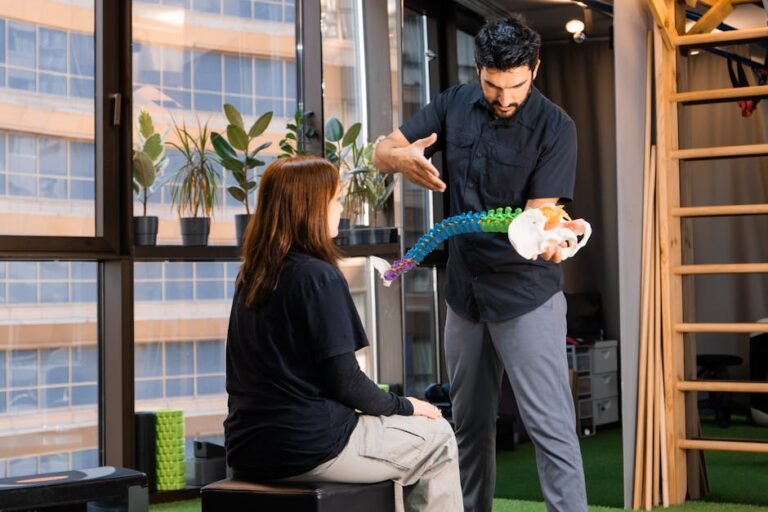
- Consider professional guidance: A physical therapist, chiropractor, or movement specialist trained in a whole-body approach can be invaluable. They can identify the specific imbalances in your kinetic chain that are contributing to your symptoms and provide a personalised plan to address them — seeing connections that are almost impossible to spot on your own.
Starting with even two or three of these habits and building gradually is far more sustainable than overhauling everything at once. Small, consistent changes accumulate into genuinely transformative results over time.
The Mind-Body Connection Within Your Kinetic Chain
There’s one more dimension of the kinetic chain that often gets overlooked: the role of stress and the nervous system. Chronic stress causes many people to unconsciously tense their shoulders, clench their jaw, or hold tension in their hips and lower back. Over time, these habitual patterns of muscle tension become part of the way the body moves — and they inevitably show up as stiffness, restricted movement, or pain somewhere along the kinetic chain.
Practices like mindful breathing, gentle yoga, tai chi, and even short daily walks have all been shown to help reduce muscle tension and encourage more fluid, balanced movement throughout the body. This isn’t about dismissing physical causes of pain — it’s about recognising that your nervous system is as much a part of your kinetic chain as your muscles and joints. Looking after your mental and emotional wellbeing is, quite literally, looking after your spine.
The take-home message here is one of integration. Your body doesn’t separate physical from mental, upper from lower, or left from right. It operates as a beautifully coordinated whole — and the more you treat it that way, the better it tends to respond.
A New Way of Thinking About Spinal Health
Shifting your perspective from “my back hurts” to “let me understand what’s happening in my kinetic chain” is genuinely empowering. It moves you from being a passive recipient of symptoms to an active participant in your own wellbeing. It encourages curiosity rather than frustration — instead of asking “why is my back doing this to me again?” you start asking “what might be going on elsewhere in my body that’s contributing to this?”
This paradigm shift is not only more accurate — it’s more hopeful. Because if pain is often the result of chain-wide imbalances built up over time, then improving those imbalances over time is entirely within reach. You don’t need to accept chronic discomfort as inevitable. You don’t need to resign yourself to a lifetime of pain management. With the right knowledge, the right support, and a willingness to treat your body as the integrated masterpiece it truly is, meaningful change is absolutely possible.
Whether you’re managing existing back pain, trying to prevent problems before they start, or simply wanting to move through life with more ease and vitality, the kinetic chain framework gives you a powerful lens through which to understand and nurture your most essential support system — your spine.
The Bottom Line: Your spine doesn’t work in isolation — it’s the central link in a whole-body kinetic chain where every part influences every other part. Understanding this interconnectedness is a genuine game-changer for spine health. By moving regularly, strengthening your core holistically, paying attention to your hips and feet, practising body awareness, and seeking professional support when needed, you can work with your body’s natural design rather than against it. Your spine is a masterpiece of biomechanical engineering — and it’s asking you to treat it that way.
This is not medical advice. Consult your healthcare provider before starting any new health routine or using any product mentioned here.