Daily Spine Mobility Exercises for Seniors: Gentle Moves for a Healthier, More Flexible Back
This post contains affiliate links. As an Amazon Associate, I earn from qualifying purchases at no extra cost to you.
Free resources — no credit card required for trial
🎧 Listen to health & wellness audiobooks free for 30 days
Start 30-Day Free Trial →
🛒 Recommended Products
As an Amazon Associate we earn from qualifying purchases at no extra cost to you.
TheraBand First Step to Active Health Kit — Senior Exercise Program for Balance and Fall P
$19.99
EZ Off Jar Opener for Seniors — Under Cabinet Jar Opener for Weak Hands and Arthritis
$9.99
Omron 5 Series Upper Arm Blood Pressure Monitor — 2-User 100-Reading Memory Wide-Range Cuf
$44.99
OMRON 7 Series Wireless Wrist Blood Pressure Monitor — Clinically Validated with Connect A
$69.99
Vitality 4 Life Senior Resistance Band with Instruction Guide — Specifically for Elderly F
$16.99
📚 Read unlimited health books free for 30 days
Try Kindle Unlimited Free →
Does your back feel a little stiffer than it used to in the morning? Do everyday tasks like bending to pick something up, turning to check your blind spot, or reaching for a shelf feel less effortless than they once did? You’re not alone — and the good news is, you don’t need a gym membership or fancy equipment to do something about it. Daily spine mobility exercises for seniors are one of the simplest, most powerful investments you can make in your comfort, independence, and overall quality of life. Just a few mindful minutes each day can ease stiffness, improve your posture, and make those everyday movements feel natural and safe again. Let’s walk through everything you need to know to get started — gently, safely, and with confidence.
Why Spine Mobility Matters More As We Age
Our spines are remarkable structures, supporting nearly everything we do — from standing and sitting to breathing and walking. But as the years pass, the discs between our vertebrae lose some of their moisture and flexibility, muscles around the back can tighten, and our range of motion naturally decreases. This is completely normal, but it doesn’t have to mean accepting stiffness as an inevitable part of life.
Keeping your spine mobile isn’t just about avoiding back pain — though that’s a wonderful benefit. It’s also about maintaining the kind of independence that lets you live life on your own terms. A flexible spine supports better posture, which in turn supports better breathing and balance. It means you can turn to greet a friend without wincing, bend down to tend your garden, or comfortably fasten your shoes. These might sound like small things, but they add up to a life that feels freer and more comfortable every single day.
The encouraging truth is that the spine responds beautifully to gentle, consistent movement. You don’t need to push hard or go far — small, controlled movements done regularly are what make the real difference. Think of it less as “exercise” and more as a daily gift to your body.
Before You Begin: Safety Tips and Starting Smart
Like any new health habit, it’s wise to start with a little preparation. If you have osteoporosis, a history of spinal fractures, chronic back pain, or have recently had back surgery or an injury, please check with your doctor before beginning a new exercise routine. Some movements may need to be adapted for your specific situation, and your healthcare provider can help you figure out what’s right for you.
Always begin your session with a brief warm-up — a minute or two of slow, deep breathing and gentle upper-body movements is enough to signal to your muscles that it’s time to move. Listen to your body throughout. There’s a world of difference between the mild, satisfying feeling of a gentle stretch and sharp or burning pain. The first is welcome; the second is a signal to stop immediately, reduce your range of motion, or try a different exercise.
A sturdy chair with a back is your best friend for most of these exercises. If you’re standing, keep a counter or wall within arm’s reach for balance support. Wear comfortable clothing that moves with you, stay hydrated, and breathe slowly and naturally — exhaling as you ease into a stretch is a great way to help tight muscles relax. Above all, remember: small movements done consistently will always outperform big, painful efforts.
A Gentle Daily Routine: Six Spine Mobility Exercises for Seniors
This routine is designed to be done in five to ten minutes, most days of the week. You can start with just four of these exercises and gradually work up to all six as you feel more comfortable. Each one targets a different type of spinal movement — flexion, extension, rotation, and side-bending — so together they give your whole spine a gentle, well-rounded workout.
Seated Cat-Cow is a wonderful place to start because it warms up the entire spine from neck to lower back while keeping you fully supported in a chair. Sit tall with feet flat on the floor. As you inhale, lift your chest slightly and let your belly move forward, creating a gentle arch — this is the “cow” position. As you exhale, press your lower back into the chair and tuck your chin gently toward your chest, rounding your spine into the “cat” position. Flow slowly between the two for six to ten breath cycles. Keep your shoulders relaxed and don’t force your neck — if the upper spine feels hard to move, simply focus on the lower and mid-back.
Seated Spinal Twist helps restore the rotational movement that makes turning your head or body feel natural and safe. Sit tall with hips stable and feet flat. Place one hand on the back of the chair or your opposite knee, inhale to lengthen your spine, then exhale and twist gently in that direction, keeping your hips facing forward. Hold for three to four slow breaths, then return to centre and repeat on the other side. Only go as far as feels comfortable — there’s no prize for forcing it.
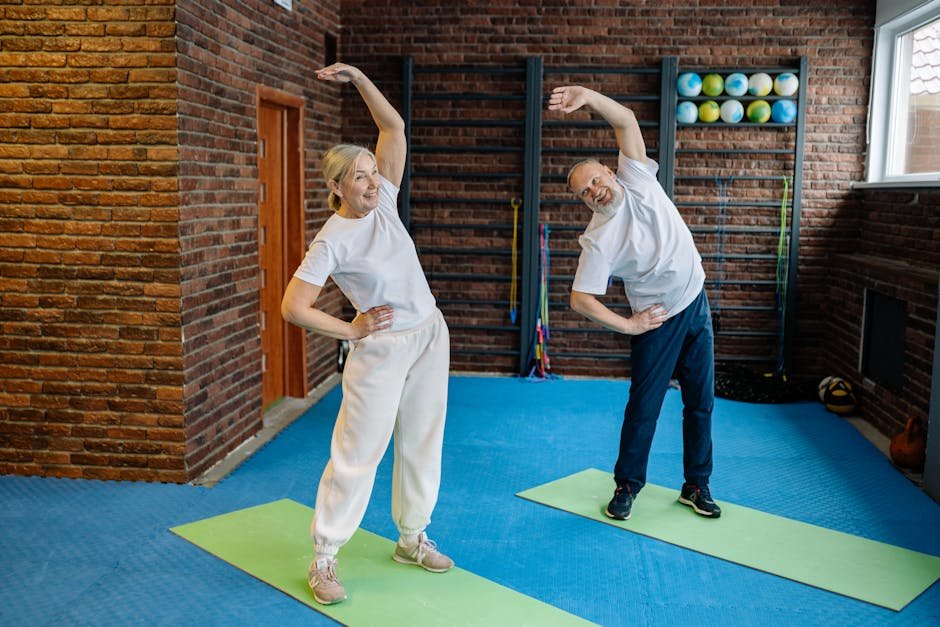
Seated Side Bend creates lovely length along the sides of your torso and back. Sit tall, then inhale to lengthen upward. As you exhale, gently lean to one side, feeling a stretch along the opposite side of your body. Hold for three to four breaths, then return to centre and repeat on the other side. If reaching your arm overhead feels unstable, simply rest your hand on the side of your body or on the chair armrest.
Seated Forward Fold is a gentle way to ease tension in the lower back and hips. Sit with feet hip-width apart, inhale to lengthen your spine, then exhale as you hinge forward from the hips — letting your upper body rest toward your thighs. Try to keep your back relatively flat rather than rounded. Hold for fifteen to thirty seconds, then slowly sit back upright. If you have tight hamstrings, bend your knees a little or place a rolled towel under your thighs for support. For anyone with osteoporosis, go very gently with forward folds and check with your doctor first.
Pelvic Tilts are deceptively simple but deeply effective for lower back comfort and better posture. You can do these lying on your back with knees bent, or seated near the edge of your chair. The movement is small: gently rock your pelvis forward to create a slight arch in your lower back, then tuck it under to flatten the curve. Move slowly, breathe naturally, and aim for ten gentle repetitions. This builds body awareness in the lower spine and helps reduce the kind of stiffness that builds up from sitting for long periods.
Supine Knee-to-Chest Stretch is one of the most soothing exercises in this routine. Lie on your back with knees bent and feet flat. Bring one knee gently toward your chest, holding it with both hands around the thigh or shin — or loop a belt or strap around your leg if reaching feels difficult. Hold for twenty to thirty seconds with slow, steady breaths, then switch legs. This stretch is wonderful for releasing tension in the lower back and hips, especially after long periods of sitting. If lying flat is uncomfortable, a modified seated version works too.
As an optional addition, Standing Wall Extensions offer a lovely release for the upper back. Stand a few inches from a wall, place your hands at shoulder height, and gently walk them up the wall as far as feels comfortable. Hold briefly, then walk them back down. Always use the wall for balance support and keep your neck relaxed.
What You Can Do: Practical Tips for Making This a Daily Habit
Knowing the exercises is one thing — turning them into a consistent habit is where the real magic happens. The good news is that five to ten minutes a day is genuinely enough to start seeing and feeling a difference. Here are some practical ways to make spine mobility a natural part of your day:
- Pick a consistent time. Right after waking up, before breakfast, or just before a favourite activity are all great anchors. The more predictable the time, the easier it becomes automatic.
- Start small and build gradually. Begin with four exercises — Cat-Cow, Spinal Twist, Side Bend, and Pelvic Tilt — and add more over the following days as your body adapts and your confidence grows.
- Keep a simple progress note. Jot down how you felt after each session, any improvements in movement, or whether you slept better. Seeing your own progress in writing is wonderfully motivating.
- Pair it with another habit you enjoy. Following your spine routine with a short walk, a few minutes of deep breathing, or a peaceful cup of tea creates a positive association that helps you look forward to it.
- Use props for comfort and safety. A sturdy chair, a yoga strap or belt for the knee-to-chest stretch, a folded towel for support under the knees or thighs — small aids can make a big difference in comfort and safety.
- Celebrate small wins. Did tying your shoes feel a little easier? Did you turn your head more freely? These are real victories worth acknowledging. Progress in mobility often shows up in everyday moments, not just on an exercise mat.
- Be flexible with your routine. Some days you’ll have more energy and time; others you won’t. On slower days, even two or three gentle movements are better than none. Consistency over time matters far more than perfection on any given day.
A Simple Starter Plan to Try This Week
If you’re wondering where to begin, here’s a gentle week-long plan to ease you in without overwhelm. Think of it as a friendly guide rather than a strict schedule — adapt it to how you feel each day.
On Day 1, try just four exercises: Cat-Cow, Spinal Twist, Side Bend, and Pelvic Tilt. Aim for five to seven minutes at an easy, unhurried pace. Notice how your back feels before and after — even the first session often brings a sense of ease and relief. On Day 2, add the Forward Fold and Knee-to-Chest Stretch for a slightly longer session of eight to ten minutes. By Day 3, you could revisit the Day 1 routine and add the Standing Wall Extension if you’re comfortable on your feet. For Days 4 through 7, rotate between the Day 2 and Day 3 routines, always listening to your body and adjusting as needed. By the end of the week, you’ll already have a feel for which exercises your body loves most — and that’s your personal routine taking shape.
Special Considerations: Adapting Spine Mobility Exercises to Your Needs
No two bodies are the same, and your spine mobility routine should reflect your unique situation. If you have been diagnosed with osteoporosis or have a history of spinal fractures, it’s especially important to approach twisting and forward-folding movements with extra care. Deep twists and forceful forward folds can place stress on vertebrae, so it’s best to keep your range of motion very gentle and get personalised advice from your doctor or a physiotherapist who understands your condition.
If balance is a concern — which is common and completely understandable — always perform your exercises seated, or stand with a counter, wall, or sturdy chair within easy reach. There’s absolutely no need to stand unsupported to benefit from these movements. The seated versions of every exercise in this routine are just as effective and often more appropriate for many seniors.
If you experience any sharp, shooting, or worsening pain during any exercise, stop immediately. This isn’t your body being dramatic — it’s important information. Rest, try a smaller range of motion when you return, and if the pain persists, speak to your healthcare provider. The goal of this routine is always comfort and ease, not pushing through discomfort.
The Bottom Line: Daily spine mobility exercises for seniors don’t need to be complicated, time-consuming, or painful to make a real difference. A few gentle, consistent minutes each day — working through movements like seated cat-cow, gentle twists, side bends, pelvic tilts, and knee-to-chest stretches — can meaningfully reduce stiffness, improve your posture, and make everyday tasks feel more natural and comfortable. Your spine responds to kindness and consistency. Be patient with yourself, celebrate every small improvement, and know that each gentle movement is an act of self-care that supports your independence and wellbeing for the long term.
This is not medical advice. Consult your healthcare provider before starting any new health routine or using any product mentioned here.