Postural Correction: How Your Brain, Senses, and Muscles Work Together to Fix Your Posture
This post contains affiliate links. As an Amazon Associate, I earn from qualifying purchases at no extra cost to you.
Free resources — no credit card required for trial
🎧 Listen to health & wellness audiobooks free for 30 days
Start 30-Day Free Trial →
🛒 Recommended Products
As an Amazon Associate we earn from qualifying purchases at no extra cost to you.
Branfit Shoulder and Back Brace Posture Corrector — Breathable Posture Trainer for Upper B
$24.99
Posture Corrector for Women and Men — Comfortable Effective Brace for Shoulder and Back Pa
$22.99
Bodywellness Posture Corrector for Men and Women — Adjustable Back Straightener with Clavi
$19.99
Updated Posture Corrector — Adjustable Upper Back Brace for Clavicle Support and Neck Pain
$21.99
Upgraded Posture Corrector Back Brace for Men and Women — Full Back Support for Neck and S
$29.99
📚 Read unlimited health books free for 30 days
Try Kindle Unlimited Free →
Do you find yourself slumping at your desk by mid-morning, craning your neck over your phone on the commute home, or rubbing that persistent ache in your lower back by evening? If so, you’re in very good company. Most of us have a complicated relationship with our posture — we know we should sit up straighter, but somehow those good intentions fade the moment we get absorbed in a task. Here’s the thing, though: postural correction isn’t simply about forcing yourself to sit ramrod straight. It’s a fascinating, whole-body process that involves your brain, your senses, your muscles, and hundreds of tiny adjustments happening every single second. Understanding how this system works — and how modern life disrupts it — is the key to actually making lasting improvements that protect your spine and help you feel better every day.
Your Spine: The Body’s Most Underappreciated Marvel
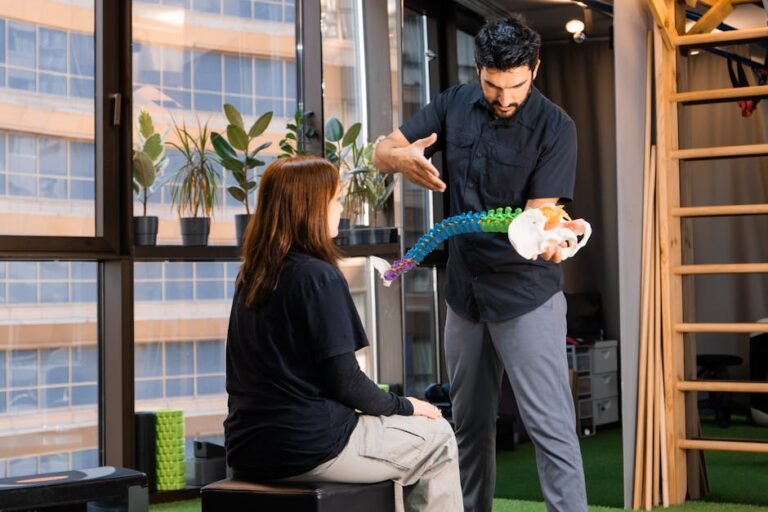
Think of your spine as the central support beam of a magnificent building — strong, stable, yet flexible enough to handle everything life throws at it. It is the core pillar of your entire musculoskeletal system, and it does far more than keep you upright. Your spine is also the protective housing for your spinal cord, the body’s communication superhighway, relaying messages between your brain and virtually every other part of you. When your spine is healthy and well-aligned, that communication flows smoothly and efficiently. When it’s not, the effects can ripple outward in ways you might not immediately connect to your back at all — fatigue, headaches, tight hips, even difficulty breathing deeply.
One of the most important things to understand about your spine is that it was never designed to be perfectly straight. It has three natural, intentional curves: an inward curve in the neck (called cervical lordosis), an outward curve in the upper back (thoracic kyphosis), and another inward curve in the lower back (lumbar lordosis). Far from being flaws, these curves act like the springs in a car’s suspension system. They distribute forces, absorb shock, and make your spine dramatically more resilient — research suggests a curved spine can withstand compressive forces up to ten times greater than a perfectly straight column could. So when we talk about good posture, we’re not talking about eliminating those curves. We’re talking about maintaining them.
When these natural curves are disrupted — flattened by slumping or exaggerated by compensating muscles — your spine loses some of its built-in protection. That’s when discomfort sets in, and that’s exactly why effective postural correction focuses on restoring those healthy curves rather than just “standing up straight.”
Postural Correction Is a Brain Game, Not Just a Physical One
Here’s where things get genuinely interesting. For years, we thought of posture as a simple mechanical problem: your body fights gravity, you hold yourself upright, job done. Modern science tells a much richer story. Your posture is actually a dynamic, continuously adaptive process — more like a sophisticated computer program running in the background than a fixed position you hold. Your body is making countless tiny, precise adjustments every moment, coordinating hundreds of muscles and integrating information from all your senses, all without you having to consciously think about it.
This process works through a continuous loop of three elements. First, there’s sensory input: your eyes track your position in space, your inner ear helps with balance, and tiny sensors embedded in your muscles and joints — called proprioceptors — send your brain a constant stream of data about where your body is and how it’s moving. Second, there’s cognitive processing: your brain takes all that incoming information, interprets it, compares it to what it expects based on past experience, and decides how to respond. Third, there’s motor output: your brain sends signals to your muscles telling them to contract, relax, or subtly shift their tension to maintain balance and alignment. If you’ve ever stood on one foot and felt your ankle making endless tiny wobbles, you’ve felt this system working in real time.
Why does this matter for postural correction? Because it means that improving your posture isn’t just about stretching tight muscles or sitting in the “right” position. It’s about re-educating this entire system — retraining the feedback loop between your senses, your brain, and your muscles. That’s what makes genuine, lasting postural improvement possible, and it’s why approaches that address movement, awareness, and habit alongside physical exercises tend to work so much better than simply “trying to sit up straight.”
Why Modern Life Is Playing Havoc With Our Spines
Our bodies are genuinely remarkable adaptive machines, but the demands of contemporary life are pushing them in directions they were never designed for. The combination of sedentary jobs, hours spent at computers, near-constant smartphone use, and declining levels of general physical activity has created what many health professionals describe as an epidemic of postural dysfunction. The body adapts to the positions it spends the most time in — and for many of us, that means hunched forward, head jutting out, shoulders rounded, core disengaged.
You’ve probably heard of “tech neck” — that forward head posture that develops from looking down at your phone or leaning toward your screen. For every inch your head moves forward from its natural position over your shoulders, the effective weight your neck muscles have to support roughly doubles. Over hours and days and years, that adds up to a significant strain. Meanwhile, long periods of sitting without proper support tend to round the upper back excessively, compress the front of the hip flexors, and either flatten or over-arch the lower back — disrupting those vital natural curves we talked about.
What makes this particularly tricky is that these postural deviations rarely stay isolated. When one part of your spine is out of alignment, other areas have to compensate. Tight hip flexors affect your lower back. A rounded upper back shifts your head forward and tightens your chest. An aching neck starts to alter how you hold your shoulders. It becomes a cycle, and over time, even simple everyday activities can start to feel uncomfortable. The encouraging news is that because this is a learned, adaptive problem, it’s also a reversible one — with the right approach.
What You Can Do: Practical Steps for Smarter Postural Correction
The beauty of understanding posture as a whole-body, brain-driven process is that it gives you multiple entry points for improvement. You don’t need to overhaul your entire life overnight. Small, consistent changes — especially ones that target both your physical habits and your body awareness — can add up to meaningful results over time. Here are practical, evidence-informed steps you can start taking today:
- Build body awareness throughout the day. Start noticing your posture regularly — when you’re sitting at your desk, standing in a queue, or scrolling your phone. You don’t need to be perfect; just check in. Are your shoulders crept up toward your ears? Is your chin jutting forward? Set a gentle phone alarm every hour as a posture prompt if it helps. Awareness is genuinely the first step in re-educating your body’s control system.
- Take movement breaks every hour. Prolonged static sitting is one of the biggest contributors to postural dysfunction. Getting up and moving for even two to three minutes every hour — a short walk, some gentle neck rolls, shoulder circles, or a few standing stretches — can reset your muscles, improve circulation, and interrupt the cycle of stiffness before it sets in.
- Strengthen your core — the right way. Your core muscles (the deep abdominal and back muscles that wrap around your spine) are your posture’s natural support system. Exercises like dead bugs, bird-dogs, and modified planks are excellent for building the deep core stability your spine needs. Pilates and yoga are also brilliant for this, as they emphasise controlled, mindful movement rather than brute force.
- Stretch what’s tight, strengthen what’s weak. Modern postural patterns tend to create predictable imbalances: tight chest muscles, tight hip flexors, and a tight lower back on one side, with weak upper back muscles, weak glutes, and weak deep neck flexors on the other. Addressing both sides of these imbalances — not just stretching, not just strengthening — is key to real, lasting postural correction.
- Set up your workspace ergonomically. Your environment shapes your posture all day long. Ideally, your feet should be flat on the floor, your knees at roughly a 90-degree angle, and your monitor at eye level so your head stays balanced over your shoulders rather than tilting forward or downward. If you use a laptop as your main workstation, an external monitor, keyboard, and mouse can make an enormous difference.
- Bring mindfulness to everyday movements. How do you lift a heavy bag? How do you stand at the kitchen counter? How do you carry your shopping? Consciously engaging your core and maintaining neutral spinal curves during routine activities turns ordinary moments into opportunities for postural improvement — no extra gym time required.
- Get a professional assessment if you’re struggling. If you’re dealing with chronic pain, persistent stiffness, or you’ve been trying to improve your posture without much progress, a session with a physiotherapist, osteopath, or chiropractor can be genuinely valuable. They can identify specific imbalances, rule out any underlying issues, and give you a personalised programme to work with.
Simple Postural Correction Habits to Build Into Your Routine
Beyond specific exercises and workspace tweaks, some of the most powerful postural changes come from small shifts in your daily habits and how you approach movement generally. One of the simplest is varying your posture regularly rather than holding any single position for too long — even a good position becomes a problem if you stay in it for hours without moving. Think of movement as medicine for your spine rather than a luxury you get to when there’s time.
Practices like yoga and Pilates deserve a special mention here because they address postural correction at multiple levels simultaneously — building strength, improving flexibility, sharpening body awareness, and training the kind of mindful, controlled movement that helps re-educate those sensory-motor feedback loops we discussed earlier. You don’t need to become a yogi; even a short 15-minute morning routine can start to shift patterns that have built up over years.
It’s also worth paying attention to how you sleep. Your sleeping position and the support your pillow and mattress provide can either reinforce healthy spinal curves or work against the progress you’re making during the day. Generally speaking, sleeping on your back with a supportive pillow under your knees, or on your side with a pillow between your knees, tends to keep the spine in a more neutral position than sleeping on your stomach with your neck twisted to one side.
How Long Does Postural Correction Actually Take?
This is one of the most common questions people ask, and the honest answer is: it depends, but it’s more achievable than most people think. Postural habits that have developed over years won’t reverse in a week — but most people start to notice meaningful improvements in how they feel within four to eight weeks of consistent effort. The key word there is consistent. A single great posture day followed by a week of slumping won’t shift the pattern. Daily small actions — a movement break here, a mindful moment of core engagement there, a regular exercise habit — accumulate into real change over time.
It’s also worth setting realistic expectations about what postural correction will and won’t fix. For many people, addressing postural imbalances significantly reduces or eliminates chronic neck pain, upper back tension, and lower back discomfort. It can improve energy levels, breathing, and even mood. What it isn’t is a magical cure for every type of spinal problem — some issues need specific medical attention, which is why professional guidance is so valuable if you’re dealing with pain that’s severe, persistent, or getting worse.
The most important mindset shift is to see postural correction not as a project with an end date, but as an ongoing practice — a way of relating to your body with more awareness and care throughout your daily life. Your spine supports you every single day of your life. It deserves the same ongoing attention.
The Bottom Line: Postural correction is about so much more than remembering to sit up straight — it’s about understanding and retraining the dynamic, brain-driven system that keeps your spine aligned, your body moving well, and your muscles working in balance. Modern life puts real pressure on that system through prolonged sitting, screen time, and reduced movement, but the good news is that your body is designed to adapt and recover. By building body awareness, taking regular movement breaks, strengthening your core, optimising your workspace, and moving more mindfully every day, you can genuinely retrain your posture from the inside out — and protect your spine for years to come.
This is not medical advice. Consult your healthcare provider before starting any new health routine or using any product mentioned here.