
Posture as a Dynamic, Adaptive Control Process: What Your Body Is Really Doing (and How to Help It)
This post contains affiliate links. As an Amazon Associate, I earn from qualifying purchases at no extra cost to you.
Free resources — no credit card required for trial
🎧 Listen to health & wellness audiobooks free for 30 days
Start 30-Day Free Trial →
🛒 Recommended Products
As an Amazon Associate we earn from qualifying purchases at no extra cost to you.
TruContour Lumbar Pillow for Sleeping — Adjustable Height Lower Back Support
$39.99
BestOffice Ergonomic Mesh Desk Chair with Lumbar Support — Adjustable Rolling Swivel Chair
$69.99
Branfit Shoulder and Back Brace Posture Corrector — Breathable Posture Trainer for Upper B
$24.99
Posture Corrector for Women and Men — Comfortable Effective Brace for Shoulder and Back Pa
$22.99
Bodywellness Posture Corrector for Men and Women — Adjustable Back Straightener with Clavi
$19.99
📚 Read unlimited health books free for 30 days
Try Kindle Unlimited Free →
Ever notice that nagging ache creeping into your neck after a long afternoon at your desk? Or maybe you’ve caught a glimpse of yourself in a mirror and wondered when your upper back started looking a little more rounded than it used to? It’s tempting to write these things off as just the price of modern life — but what if those small discomforts are actually signals from one of the most sophisticated systems in your entire body? The truth about posture is far more fascinating than anyone ever taught us in school. It’s not simply about “sitting up straight.” Posture is a continuous, dynamic, adaptive control process — happening every single second, completely beneath your awareness — and understanding how it actually works is one of the most empowering things you can do for your long-term spine health and overall wellbeing.
What Posture Really Means: It’s Not What You Were Taught
Most of us grew up thinking posture meant holding a rigid, upright position — shoulders back, chin tucked, chest out. Maybe a teacher or parent reminded you to “stop slouching” and you’d snap upright for thirty seconds before drifting back. The problem with that model is that it treats posture as a fixed, static thing. Modern science paints a completely different picture, and it’s actually a lot more interesting.
Posture is best understood as a dynamic, adaptive control process — a constant, real-time conversation between your brain, your nervous system, your muscles, and your senses. From the moment you open your eyes in the morning to the moment you drift off to sleep, your postural system is working behind the scenes without you even noticing. It integrates what your eyes are seeing, what your inner ear is sensing about balance and movement, and what your muscles and joints are feeling — all at once, all the time.
In milliseconds, your brain processes all of this incoming information and fires off signals to hundreds of muscles across your body. Those muscles then coordinate to stabilize your joints, support your spine, and keep you balanced and efficient — whether you’re reaching for something on a high shelf, walking across an uneven pavement, or simply sitting and reading. This is why posture is so much more than a shape you hold. It’s a living, breathing, constantly adapting system. And understanding that is the foundation for everything that follows.
Your Spine: An Engineering Marvel Built for Movement
At the centre of your postural system sits your spine — and it is genuinely one of nature’s most impressive pieces of engineering. Your spine isn’t just a rigid pole keeping you upright. It’s your body’s central support pillar, protecting your delicate spinal cord while simultaneously allowing for an enormous range of movement. The secret to how it manages both jobs lies in its natural S-shaped curves.
These three curves — the gentle inward curve of your neck (called cervical lordosis), the outward curve of your upper back (thoracic kyphosis), and the inward curve of your lower back (lumbar lordosis) — are not design flaws or signs of weakness. They are functional necessities, shaped by millions of years of evolution. Working like natural springs, these curves distribute your body weight evenly, absorb shock as you move, and make everyday activities feel effortless. Remarkably, these curves actually allow your spine to withstand compressive forces up to ten times greater than a perfectly straight column could handle. They’re why you can jog down the street without rattling your brain, and why you can lift shopping bags without crumbling under the load.
Here’s the issue though: modern life is placing unprecedented demands on this beautifully designed system. Hours hunched over keyboards, the constant downward pull of our eyes toward smartphone screens (a phenomenon now widely called “tech neck”), and generally more sedentary lifestyles have created what many health experts describe as an epidemic of postural dysfunction. It’s not about vanity or posture being “old-fashioned.” It’s about the fact that our lifestyles are quietly working against the very structure our bodies evolved to maintain — and our spines are paying the price.
The Hidden Costs of Poor Posture: A Cascade Effect Through Your Body
When your dynamic postural system is repeatedly pushed beyond its ability to adapt, the effects don’t stay isolated in one spot. They ripple outward in a cascade that can affect your entire body. The spine’s natural curves can begin to shift — your neck might gradually lose its healthy inward curve, your upper back might become excessively rounded, your lower back might flatten or over-exaggerate. These changes are called postural deviations, and they’re far more than a cosmetic concern. They fundamentally alter how your body distributes weight and absorbs the forces of daily movement.
Think of it like a single domino falling and triggering a chain reaction down the line. Forward head posture — where your head drifts in front of your shoulders — is a perfect example. For every inch your head moves forward, the effective weight your neck muscles have to support increases dramatically. The result? Chronic neck pain, persistent headaches, and tight, aching shoulders become your new normal. An excessively rounded upper back can restrict your breathing capacity, compress nerves running down your arms, and force your lower back to compensate with its own curves — leading to lumbar pain that seems to come from nowhere.
These compensatory patterns spread further still. Your hips might tilt out of alignment, your knees might hyperextend, even your foot arches can flatten — all of them trying to make up for an imbalance that started higher up. Over time, this constant compensation creates muscle imbalances where some muscles become weak and overstretched while others are perpetually tight and overworked. Joints stiffen. Nerves get irritated. What begins as occasional discomfort can solidify into the kind of chronic musculoskeletal pain that affects your concentration, your sleep, your mood, and your quality of life. These are not small problems, and they deserve real, thoughtful attention.
Why Your Posture Is Always Changing — And Why That’s Good News
Here’s something genuinely encouraging: because posture is a dynamic, adaptive control process rather than a fixed structure, it means it can change. Your body is not locked into its current patterns. The same adaptability that allowed poor posture to develop can be harnessed to restore better alignment, healthier movement, and less pain. This isn’t about straining to hold an unnatural military-straight position. It’s about gradually helping your body rediscover the balance it was designed for.
Real postural improvement works on several levels at once. It addresses the visible habits — how you sit, stand, and hold your phone. But it also works deeper, targeting the muscle imbalances, restricted tissues, and ingrained movement patterns that have built up over time. Think of it less like correcting a bad habit and more like retraining a system. With consistent, gentle effort, your nervous system can learn new movement patterns, your muscles can find better balance, and your spine can return to something much closer to its natural, efficient alignment.
The key word here is consistency. Grand gestures — buying an expensive ergonomic chair and then sitting in it exactly as you did before — won’t move the needle. Small, repeated changes, layered on top of each other over weeks and months, are what genuinely transform your posture and reduce the strain on your spine. And the good news is that many of the most effective changes cost very little and can be woven into your daily routine starting today.
What You Can Do: Practical Tips to Support Your Postural System
Supporting your body’s natural postural control system doesn’t require expensive equipment or hours at the gym. What it does require is awareness, intention, and a little consistency. Here are some practical, evidence-informed steps you can start with right now:
- Build awareness first. You can’t change what you don’t notice. Start checking in with your body throughout the day — are your shoulders creeping up toward your ears? Is your head jutting forward? Is your lower back rounded or supported? Setting a gentle hourly reminder on your phone can help build this habit until it becomes second nature.
- Move more, and more often. Your body was designed for movement, not prolonged stillness. If you work at a desk, aim to take a short break every 20 to 30 minutes — stand up, walk to get a glass of water, do a few gentle stretches. Even micro-movement breaks throughout the day can significantly reduce the postural strain that builds up over hours of sitting.
- Strengthen your core and posterior chain. A strong core — which includes your deep abdominals, back muscles, and glutes — provides the muscular foundation that good posture depends on. Exercises like planks, glute bridges, and gentle back extensions are excellent starting points. Balance these with stretches for commonly tight areas like your chest and hip flexors.
- Optimise your workspace ergonomically. Position your computer screen at roughly eye level so your neck isn’t angled up or down. Keep your feet flat on the floor and your keyboard and mouse comfortably within reach to avoid shoulder strain. When using a phone, try raising it toward your face rather than dropping your head toward it — your neck will thank you.
- Pay attention to your body’s signals. Persistent aches, stiffness, and tension are your body’s way of communicating that something needs attention. Don’t normalise chronic discomfort. It’s rarely “just the way it is” — it’s usually a sign that a postural or movement pattern needs to change.
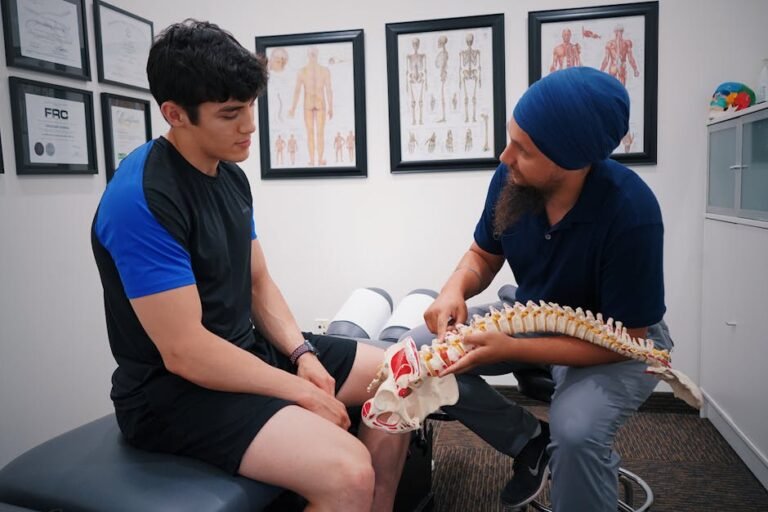
- Consider professional support. If you’re dealing with chronic pain, noticeable postural changes, or you’re simply not sure where to begin, working with a physical therapist, chiropractor, or qualified movement specialist can be tremendously helpful. They can assess your specific patterns, identify what’s driving your symptoms, and guide you through a personalised plan far more effectively than any generic advice.
- Look at supportive products thoughtfully. Ergonomic tools — lumbar support cushions, monitor stands, posture reminder devices, resistance bands for strengthening — can be genuinely useful additions to a broader postural strategy. Just remember they’re tools, not solutions on their own.
Building Lasting Change: The Long Game of Posture Correction
It’s worth being honest about expectations here. If your postural patterns have been building for years or even decades, they won’t reverse in a week. And that’s completely okay. The goal isn’t perfection — it’s progress. Every time you catch yourself and gently adjust, every movement break you take, every strengthening session you complete — these are all deposits in an account that will pay dividends in how you feel, move, and function over the long term.
It helps to reframe how you think about posture correction entirely. Rather than viewing it as a chore or a constant battle against your body’s bad habits, try seeing it as learning to work with a highly intelligent system that has simply been adapting to some less-than-ideal circumstances. When you provide it with better input — more movement, stronger supporting muscles, more ergonomic environments — it responds. It adapts. That’s what it was designed to do.
There will likely be days when neck stiffness returns, or you catch yourself deeply hunched over your laptop again. That’s normal. The measure of progress isn’t whether those moments happen — it’s how quickly you notice them, and how naturally your body starts to find its way back to better alignment. Over time, with patience and consistency, that process becomes increasingly effortless. Your new default begins to shift. And the chronic aches that once seemed like an unavoidable feature of your life start to become less frequent, less intense, and less defining.
The Bottom Line: Posture is not a rigid position you force yourself into — it is a dynamic, adaptive control process that your brain and body are managing every moment of every day. Your spine’s natural curves are brilliantly designed to support you through a lifetime of movement, but modern sedentary habits, screen time, and lack of movement are quietly working against that design. The resulting cascade of muscle imbalances, compensation patterns, and chronic pain is real — but so is your power to change it. By building body awareness, moving more consistently, strengthening your supporting muscles, and creating smarter environments for work and rest, you can genuinely shift your postural patterns over time. Your spine is a masterpiece. Give it the support it deserves.
This is not medical advice. Consult your healthcare provider before starting any new health routine or using any product mentioned here.